
American Intelligence
I grew up in Camarillo, California: fertile soil, Mediterranean climate, strawberries, avocados, lemons, citrus, and family farms passed down through generations. The kind of place that sells itself, and does.
Read the city’s own description of its agricultural economy and you will find every word you would expect: rich agricultural legacy, farming passed down, agricultural education, sustainability, drip irrigation, precision sensors, AI-driven robotics, research partnerships, and a North American AgTech market projected to reach $16 billion by 2027.
Read it again and notice what is missing.
The workforce.
Not wages. Not labor. Not who picks the strawberries, cuts the lemons, or brings in the harvest. The fields produce. The technology advances. The legacy continues. The workers disappear.
Every agricultural economy has a legacy. The question is which part is being preserved. The fertile soil is a legacy. The family farms are a legacy. The harvest is a legacy. So is the labor model that brings it in. And across American agriculture, that model has for forty years depended heavily on foreign labor, illegal hiring, and a political class determined not to disturb either.
When a city brochure pairs “legacy” with AI robotics in the same breath, it is not just describing the future. It is making a quiet promise: the technology will advance, but the labor model will not.
America is preparing for the AI age everywhere except the place that feeds the country.
In Washington, the debate tends to revolve around foundation models, export controls, chips, data centers, defense contracts, and the ideological capture of Silicon Valley. Those fights matter. But the next frontier of artificial intelligence will not stay confined to server farms or federal procurement offices. It will also play out in fields, dairies, orchards, irrigation networks, greenhouses, and the rural labor markets that underpin America’s food supply.
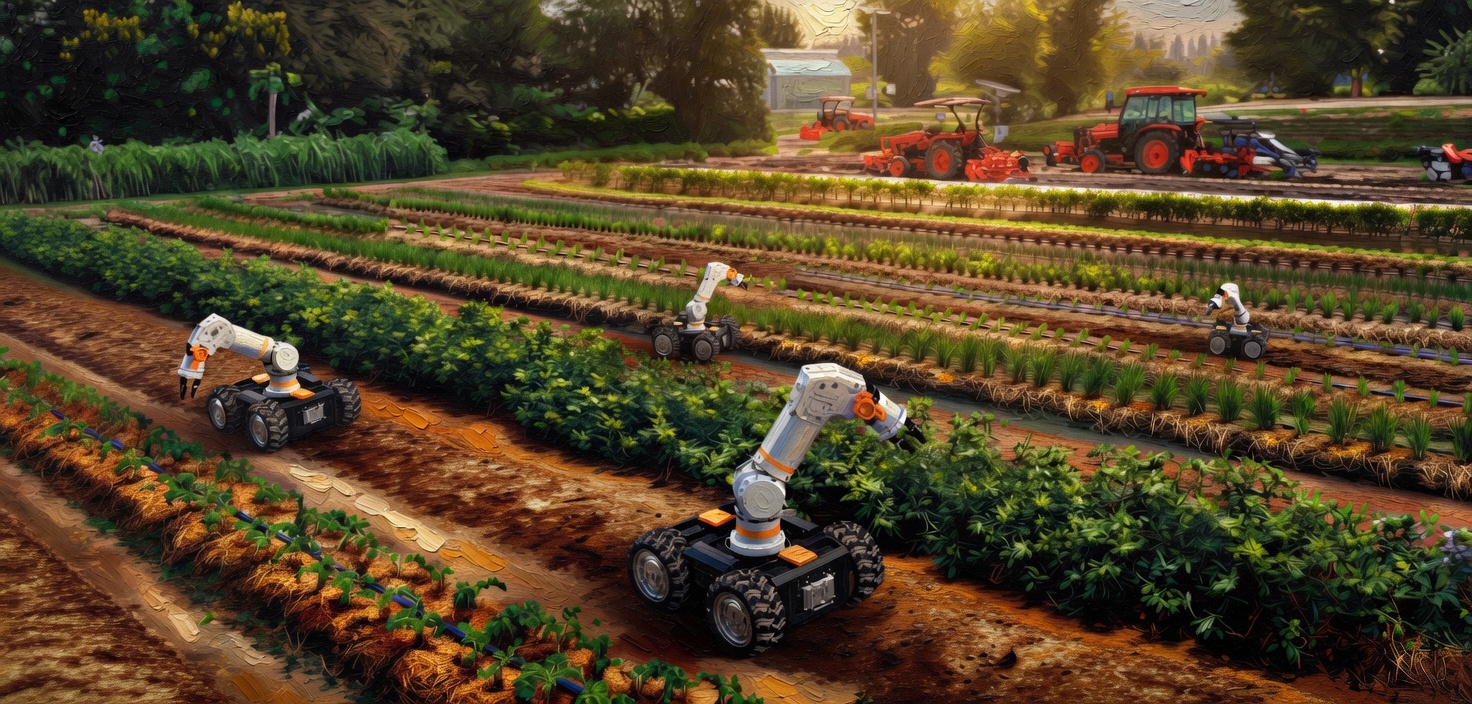
That frontier is no longer theoretical. Autonomous tractors already plant, till, and spray without a driver. Computer-vision systems can scout crops plant by plant. Machine-learning models can optimize water, fertilizer, pest control, and yield down to the meter. Robotic harvesters can pick faster, cleaner, and longer than hand crews. Precision irrigation can be guided by satellite analytics. AI-assisted breeding can compress decades of plant selection into months.
The question is no longer whether American agriculture can automate. It is whether Washington will stop subsidizing the cheap labor model that makes automation a losing bet.
America should be leading this revolution. It builds the software, funds the research, trains the engineers, and talks constantly about technological dominance. Yet federal policy still props up an agricultural labor model built on cheap imported labor, illegal hiring, and guestworker expansion. That bargain has kept human labor cheaper than machines, delayed mechanization, and now risks leaving the United States on the sidelines of a revolution it should own.
This is not a speculative warning. It is already underway. Syngenta’s Cropwise platform now spans more than 70 million hectares across 30 countries. The World Economic Forum projects that AI-amplified digital agriculture could increase agricultural GDP in developing economies by more than $450 billion annually. The Netherlands, Israel, and Australia are moving quickly to capture that ground.
American firms built much of the underlying technology. American universities produced the foundational research. American workers could be trained to operate it.
But the United States will not lead unless it dismantles the cheap labor regime that has allowed agriculture to skip the last revolution while pretending it is ready for the next.
You cannot leapfrog to autonomous agriculture over an industry that has barely mechanized. Software runs on hardware. AI runs on physical capital. The autonomous tractor still requires the tractor. The computer-vision yield system still needs the machine it is guiding. The machine-learning dairy platform still depends on the milking robot it is reading from. Farms that have not mechanized cannot become intelligent by press release.
The capital does not move. The infrastructure does not get built. The workforce does not get trained. The frontier goes to whoever did the prior work first.
Why has American agriculture failed to do that work?
Not because of technology. The tools have been available for decades.
The answer is policy. Washington has spent forty years making cheap foreign labor cheaper than the machine.
The Twin Pillars of the Cheap Labor Regime
American agriculture runs on a labor system Washington built, tolerated, subsidized, and now refuses to dismantle. It rests on two pillars.
The first is illegal hiring. Federal surveys show that roughly 40 to 45 percent of crop farmworkers lack legal work authorization. In California, the share is closer to 60 percent. Another large portion are foreign nationals who entered illegally or came on a temporary basis. The U.S.-born legal workforce in the fields is the minority.
This is not a system failure. It is the system. And it has been propped up by both parties.
The second pillar is H-2A, the federal guestworker program designed in 1986 as a narrow tool for seasonal shortages. It has since grown into one of the largest labor pipelines in the immigration system.
The Department of Labor certified roughly 385,000 H-2A jobs in FY 2024, nearly an eightfold increase since 2005. The program remains uncapped by statute. Recent rulemaking is projected to transfer tens of billions in wage value over the next decade, in some cases lowering effective labor costs by several dollars per hour.
Washington is making imported labor cheaper at the exact moment it should be forcing capital toward machines.
These pillars are not separate problems. They are the same subsidy delivered through different channels, defended by the same interests, and sustaining the same method.
When enforcement targets illegal hiring, employers demand H-2A expansion. When H-2A reform is proposed, they revive amnesty proposals like the Farm Workforce Modernization Act, which would grant Certified Agricultural Worker status and eventual green cards to up to 2.1 million illegal alien farmworkers while simultaneously opening H-2A to year-round industries.
The lobby’s actual position is not legal labor or illegal labor. It is permanent access to cheap foreign labor by whatever channel Washington will tolerate.
Illegal hiring supplies the shadow workforce. H-2A provides the legal release valve. Amnesty converts one into the other while preserving the pipeline behind it.
This is not stagnation by accident. It is by design.
The result is a labor-intensive production model with little incentive to mechanize, little reason to invest in agricultural intelligence, and no pressure to train American workers to operate either.
That helps explain why the United States lags Northern Europe in robotic milking, Israel in precision irrigation, and Australia in autonomous platforms.
Those countries did not discover secret technologies unavailable to American farmers. They built the workforce and mechanized base the United States has chosen to avoid.
We chose decades of cheap, and often illegal, foreign labor instead.
The Myth of the Impossible Crop
Big Agriculture’s most persistent claim is that American farming cannot be mechanized. The crops are too delicate. The terrain too uneven. The seasons too unpredictable. The farms are too diverse. The margins are too thin. The labor is supposedly too specialized.
Some of these objections contain fragments of truth. None justify a permanent federal subsidy for cheap foreign labor.
The “impossible crop” argument collapses the moment policy forces capital to solve the problem.
Commercial cabbage harvesters have existed for decades. Autonomous systems are now being developed for uneven terrain. Apple harvesting robots can pick roughly 10,000 apples an hour, about 30 to 50 times human speed, with less bruising than human crews.
Harvest CROO’s strawberry robots replaced crews of 30 migrant pickers with a small team of engineers and technicians and reached commercial viability in 2025. Carbon Robotics’ LaserWeeder uses AI-guided precision lasers to eliminate up to 5,000 weeds a minute, replacing the work of a hand crew of 75 people. Monarch Tractor’s MK-V is a fully electric, driver-optional tractor now operating on hundreds of farms. Bear Flag Robotics, now a John Deere subsidiary, retrofits existing tractors for autonomous tillage at scale.
Even crops long considered unmechanizable are starting to be mechanized.
The constraint is not engineering. It is incentive. And when the incentive shifts, capital tends to follow.
Dale Hemminger, an upstate New York dairy farmer, installed his first milking robots in 2007 after immigration authorities arrested one of his workers. Before mechanization, his farm produced about 800,000 pounds of milk per worker per year. Today it produces 2.5 million. About a dozen workers manage a herd of more than 2,000 cows. They earn more than typical farmworkers and work shorter hours.
That is what one enforcement event did on one farm.
Now imagine that incentive applied across the entire sector.
Bracero Proved the Point
America has already run this experiment.
From 1942 to 1964, the Bracero program admitted more than 4.6 million Mexican guestworkers. At its peak, it brought in more workers annually than today’s entire H-2A system.
The same arguments were made then: crops would rot, Americans would not work, mechanization was not ready.
Congress and President Lyndon Johnson ended the Bracero program in 1964.
The result was not collapse. It was modernization.
Tomato harvesters, developed at the University of California with public funds, were commercially deployed within five years. California processing tomato yields rose 300 percent while labor requirements fell by more than 80 percent. Real wages for remaining domestic farmworkers rose substantially. Crop losses were short-lived and concentrated in the first two seasons. Total production soon exceeded pre-termination levels.
The lesson is straightforward.
The technology was already there. Modernization was obstructed by outdated policy.
That lesson applies directly today.
End the federal guarantee of imported labor. Mandate E-Verify. Phase down H-2A on a real timeline. Reject amnesty that converts the existing illegal workforce into a permanent labor base while expanding future inflows.
No carve-outs. No indefinite delays.
Transition should be statutory, not chaotic. Enforcement must be paired with date-certain phase-downs, mechanization credit, and accelerated expensing. The point is not to create a harvest shock. It is to deny agribusiness the one thing that has defeated every reform for forty years: indefinite delay. Put serious public investment behind mechanization and agricultural intelligence in tandem, on the model of the semiconductor and energy industrial policies of the past five years. Pair the phase-down with targeted USDA credit for mechanization, accelerated expensing for qualifying capital investments, shared-ownership equipment consortia that put commercial-grade robotics within reach of smaller farms, and scale-tiered timelines that give family operations more runway than consolidated agribusiness.
Capital should move toward modernization, not toward Capitol Hill.
The Constituency This Is For
The Right often talks about building a worker-centered coalition. Agriculture is where that idea could actually take shape.
It is composed of the small dairy operator competing against a contractor-driven megafarm that lobbies for both illegal labor and H-2A expansion. It harbors the rural mechanic who could be trained as a robotics technician on a precision orchard. It uplifts the recent graduate of a community college agronomy program who could work in autonomous-equipment maintenance, computer-vision crop scouting, or precision-irrigation management. It represents the American worker who lost the field job a generation ago and never got the engineering job that should have replaced it, because the engineering job was never built.
Cheap, and oftentimes illegal, foreign labor does not just displace today’s American worker. It prevents tomorrow’s worker from emerging.
It blocks the investment that would create better jobs. It keeps rural America trapped in a low-wage equilibrium, and then frames that outcome as a necessary tradeoff.
It is not.
The Sovereignty of Food
The global agricultural intelligence revolution will not wait for American policy to catch up. It is happening now, on Dutch dairies, Israeli irrigation networks, Australian autonomous platforms, and in the orchards and greenhouses of countries that did the prior work, built the prior infrastructure, and trained the prior workforce.
But it does not have to be this way. American startups are building the machines. The United States can deploy them at scale, or watch other countries integrate the technology American firms invented.
The AI age is not just about who builds the model. It is about who controls the systems the model governs.
A country that imports foreign labor to prop up its food system, neglects the machines that should replace it, and fails to train its own workforce is not leading. It is stepping aside.
If “America First” means anything in the AI age, it means that the commanding systems of national life are built, operated, and controlled by Americans. Food is one of those systems.
The United States has the advantages: land, capital, universities, manufacturers, and workers.
What it lacks is the political will to end the old bargain.
For forty years, Washington has kept imported labor cheaper than machines. That decision has lowered wages, slowed mechanization, weakened the rural workforce, and delayed the productivity gains other countries have already captured.
Now the next revolution is here.
The choice is straightforward: a preindustrial labor system sustained by outdated and poor policy, or an industrial strategy worthy of a sovereign nation.
We should end the cheap foreign labor regime. Mandate E-Verify. Phase out H-2A. Restore wage discipline. Invest in mechanization and agricultural intelligence at scale.
America cannot shape the future of food while importing a labor model of the past.
There is no third option.
Coming soon from NICE: Phasing Out H-2A: How to Force American Agriculture into the 21st Century. A national mechanization and agricultural intelligence initiative built for American workers and American farms. The full case for ending Big Agriculture’s cheap labor racket and forcing the modernization that should have come a generation ago.