
American Intelligence
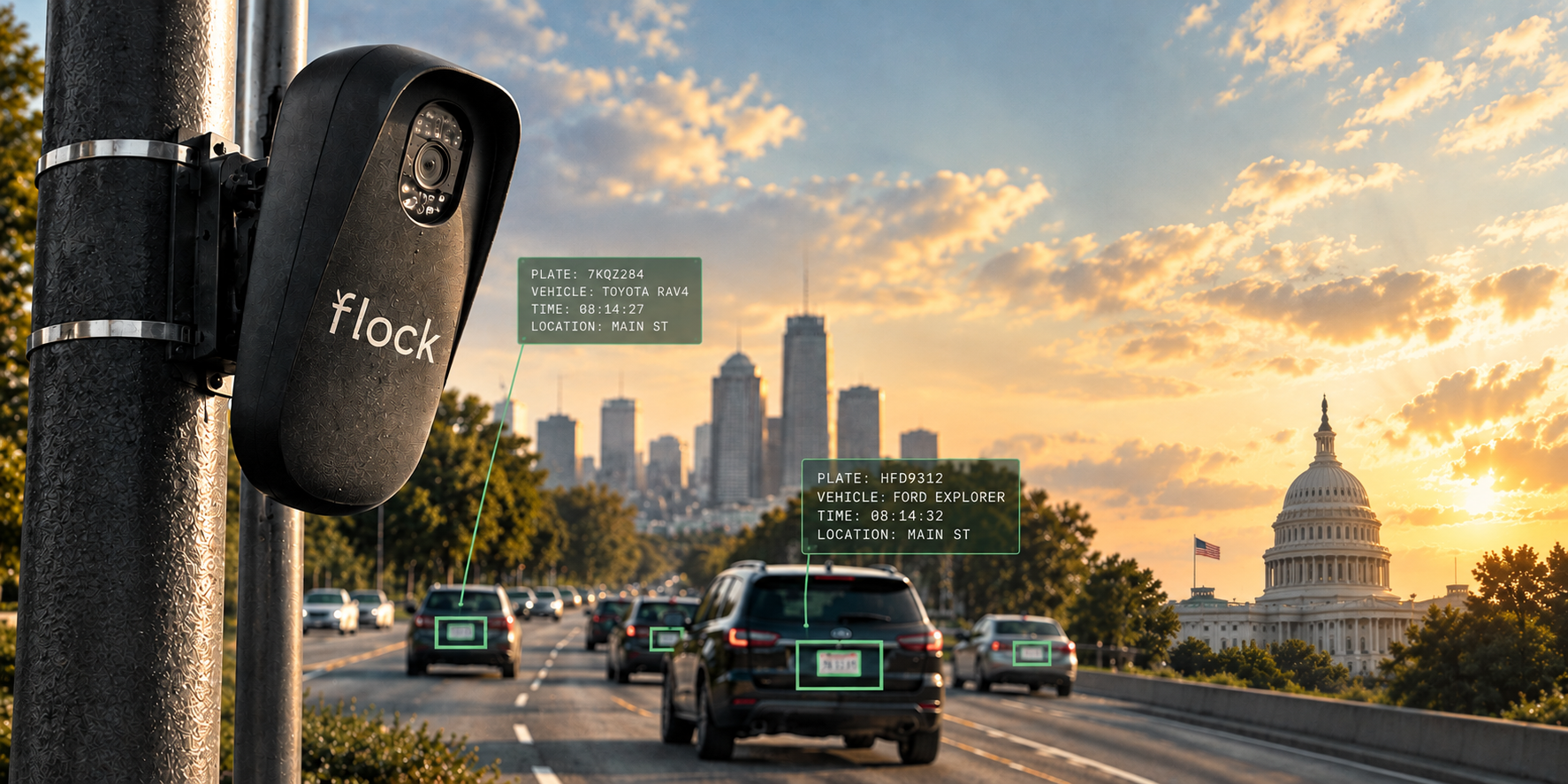
Technology is eating the state. Anduril appears on track to become a defense prime. Palantir is probably the most talked-about contractor in the history of the U.S. intelligence services. Increasingly, Flock occupies a similar position in the world of policing.
The company’s signature product is an automated-license plate reader (ALPR). Locales use Flock cameras to clock vehicles as they traverse public roads. Should a crime occur nearby, law enforcement can conduct a license plate search in hopes of finding a lead.
According to the company’s own estimates, Flock’s systems were used in over a million criminal investigations and helped locate over ten thousand missing persons in 2025.
Local departments have provided data of their own. League City, Texas, reported that its Flock cameras had played a role in 305 investigations — for crimes such as homicides and burglaries — in the year leading up to July 2026.
Similarly, Raleigh, North Carolina, credited Flock with 41 arrests over 6 months. On August 13th, Flock led to an arrest for an apparent triple homicide.
For all its strengths as a nation, the United States is a uniquely violent country compared to the rest of the developed world. Violent offenses are meaningfully rarer than they were at their peak in 1991, but World Bank data puts our homicide rate a little higher than Kenya’s and a little lower than Paraguay’s.
Most of us can get through the day without encountering serious crime. We would prefer if the numbers I just cited were moving in the right direction, but even at current levels, events like homicides and burglaries feel like reasonably remote risks as long as we take normal precautions.
This way of experiencing crime is misleading. Beyond the small risk of personal catastrophe, we live in a society that’s been crime-proofed in ways both obvious and subtle.
High crime rates nudge societies to restrict public spaces, fail to invest in public goods, limit housing density even amid dire shortages, and — probably most visibly — lock up toothbrushes at drug stores.
To the extent they can address crime, ALPR systems like Flock’s stand to promote quality of life gains that are more tangible than simply reducing personal risk.
Whether they see these connections or not, the American people are eager to mitigate the country’s crime problems. Eighty-one percent of Americans said that crime was an important issue for them in the upcoming midterm elections. Notably, Republicans and Democrats now poll more similarly on this issue than they have in the past.
Still, Flock has drawn the ire of both libertarians on the right and progressives on the left.
Rep. Thomas Massie has proposed legislation to prevent Flock from receiving federal funding. Sen. Ron Wyden has called on communities to remove Flock cameras altogether. Flock criticism on the left and right share a dominant theme: the fear of error and misuse.
What counts as misuse is where ideological differences begin to reassert themselves. Wyden’s attacks on the company were based in part on the claim Immigration and Customs Enforcement (ICE) had sometimes gained access to Flock data. It’s difficult to imagine many conservative Flock critics taking that particular line.
But other concerns lend themselves more to consensus: that Flock-originated errors will lead to bad interactions between innocent suspects and law enforcement, and that some law enforcement personnel will use Flock systems to conduct searches for inappropriate or illegal purposes.
Recall IBM’s dictum that a computer must never make a decision because it can never be held accountable. Flock critics often do seek to hold the technology accountable for human error and misuse.
Police will always operate on imperfect information. They will always pursue spurious leads and the wrong suspects at times. If this happens because Flock misread a license plate, the technology is no more at fault than human witnesses are when they misapprehend or misremember details.
The solutions are the same ones we’ve always relied on: the presumption of innocence and professionalism on the part of officers.
In the case of deliberate misuse, the solution is even more obvious: human accountability. Flock’s systems are auditable by design. That we’ve uncovered cases of officers using systems to track former romantic partners, to take one commonly repeated example, actually shows that such accountability is possible.
If the United States has any hope of matching the rest of the developed world’s standards of public safety, it will be found partly in better tools. The technology itself will only mature, and law enforcement agencies will discover best practices along the way.
If our society fails to live up to the promise of this technology, we should at least acknowledge that isn’t the fault of the tool or the toolmaker.