
American Intelligence
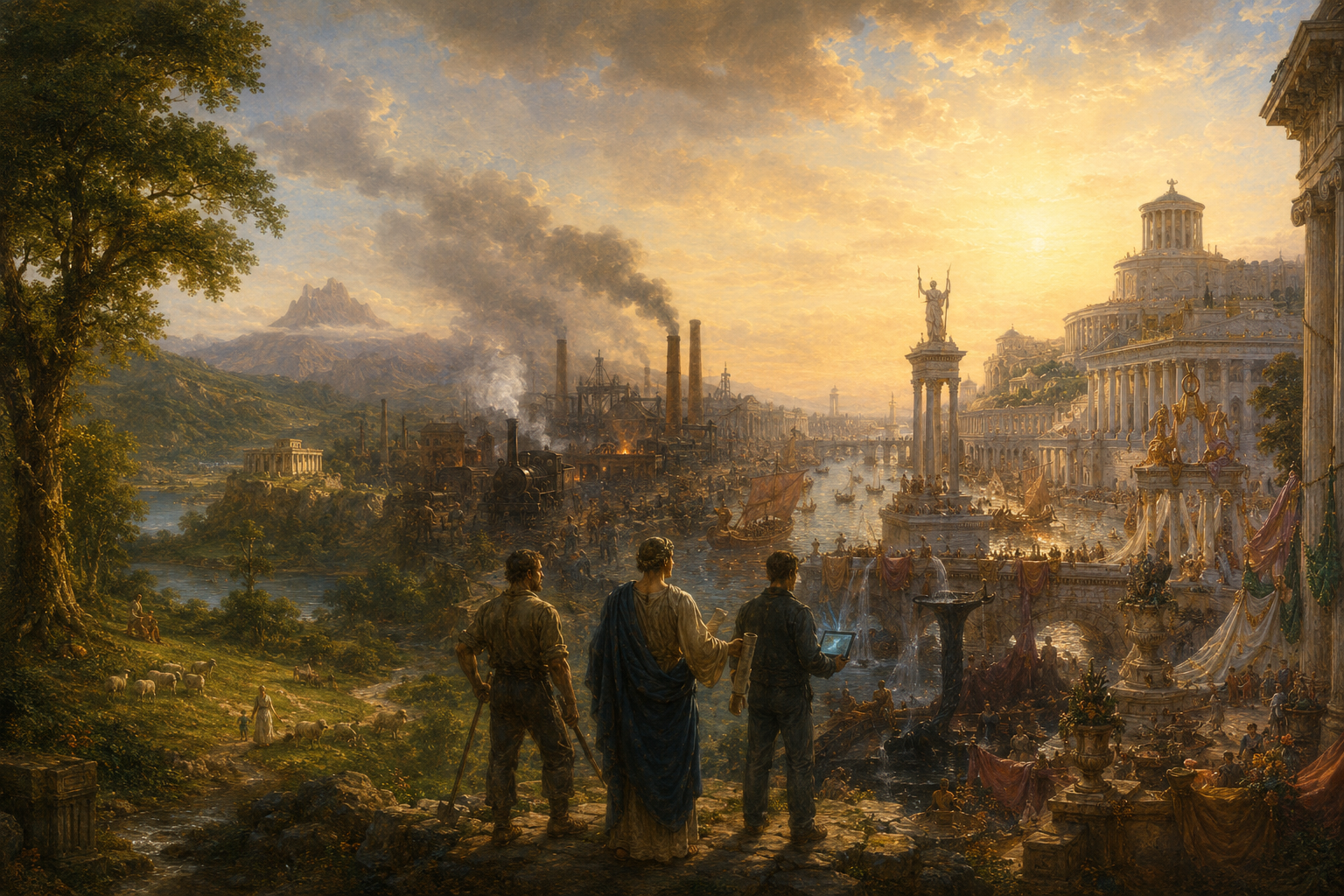
The AI revolution is not merely a story about technology, but a story about extreme economic and social disruption.
Every major economic revolution has forced the same three reckonings on the civilizations that lived through them:
1) How to navigate the transition without destroying those it displaces,
2) How to redesign the monetary order before wealth concentrates beyond recovery,
3) And how to build an economic system suited to the new conditions without abandoning what is true about human nature.
Agricultural, commercial, industrial, and digital revolutions. Each produced transitions far more painful than their architects anticipated. So much so that historians have attempted to sanitize these transitions into progressive narratives, written comfortably by those who escaped the worst parts of the suffering.
We are at the opening of a new transition. The promises appear arresting: abundance, efficiency, innovation but so are the warnings: displacement, wealth concentration, social collapse. Both outcomes are possible, however, neither is guaranteed. What will determine the outcome is whether we understand patterns well enough to navigate what’s ahead.
I. THE VALLEY OF TRANSITION
History recalls outcomes more often than the substance associated with each transition. We know the Roman Empire fell, but not much about the decade when a Roman farmer first understood that the world he was born into no longer existed. We know the Industrial Revolution created modern prosperity, but the Luddite textile workers of the 1810s knew only that the machines had taken their craft, their income, and their dignity, and that no one in power seemed to care.
This is the first lesson: transition stages contain human catastrophes, economically and socially, even when the ultimate destination is good.
Unlike earlier disruptions, globalization and the digital revolution offer a case study within living memory. We would be wise to learn from it.
AI presents a problem that is structurally familiar to globalization and the digital revolution, but it is substantively unique. While previous revolutions displaced physical labor and forced a trickle-down adaptation to cognitive work, this revolution targets the cognitive layer more directly.
That distinction matters more than it first appears. It means the disruption is aimed precisely at the workforce America has spent the last fifty plus years deliberately constructing. When manufacturing left for cheaper shores, we traded factory floors for degree mills and told generations of young people that the path to a stable, dignified life ran through white-collar credentialism.
With mass layoffs now announced on a near-weekly basis, a sense of betrayal is swelling as the response to what many feel is a broken promise. Unemployment tracks along demographic and class lines, compounding existing fractures and, as it stands, we have become less of a coherent, high-trust society with shared values equipped to absorb this kind of collective shock.
Instead, we are a multicultural, post-institutional society already in the throes of a crisis of meaning and identity. One in which addiction, suicide, declining family formation, and collapsing civic participation were all rising before the first large language model (LLM) even shipped. This was a policy choice, and while some may argue otherwise, it was done by design.
Work is teleological, not simply a question of economics. It structures time, confers identity, and situates the individual in relation to others. Strip large populations of meaningful work without offering a compelling alternative source of purpose and you no longer get a policy debate. You get what every previous transition produced: social rage, extremist ideologies, and a cultural collapse for those who struggle to adapt.
What should we be doing instead? “Letting the market decide” with “new jobs we can’t yet imagine” is a trite and unhelpful imposition often provided to the Zoomers. A more honest answer would be that we need to reorient the labor pipeline around three functions.
First, build. The physical infrastructure AI requires (chips, data centers, power grids) represents the largest capital investment cycle since the interstate highway system. The workforce to build it does not currently exist at scale. Technical education and the trades are not a consolation prize for those who couldn't go to college, AI makes them a strategic priority.
Second, integrate. The small and local businesses that form the connective tissue of the real economy (the contractors, local restaurants, and regional manufacturers) will be left behind because its owners and operators either do not know how, or do not have the time to learn how, to use the tools that streamline their operations, sales, marketing, accounting, etc. This is where the productivity gains of AI can be most broadly distributed and it is receiving the least attention.
Third, create. Technology democratizes the means of production and value creation. Today, a single innovator can ideate, plan, and execute what once required an entire team and millions in startup capital. That capacity needs to be cultivated, not left to chance. (For a fuller treatment of this framework, see "The Labor Realignment," Fully Alive.)
II. HOW WE DO MONEY
Each economic revolution has reorganized how value is stored and exchanged.
Agricultural surpluses made barter viable. Commerce demanded something portable: gold and silver. Industrial scale demanded something more elastic and so we got paper money backed by gold reserves. The digital economy demanded speed and global reach and got fiat currency, paper backed by sovereign authority and collective belief. Each monetary system was a response to the productive logic of its era. The AI revolution will demand another.
The promise of fiat was that a currency system unconstrained by physical scarcity could be directed toward broad social ends. If the state controls the money supply, it can, in theory, expand it in ways that lift the floor rather than raise the ceiling. But that is not what has happened.
Fiat currency, in practice, inflates asset prices. Importantly, the wealthy do not hold cash, they hold equities, real estate, private equity, and commodities. When central banks expand the money supply, they don’t widely distribute purchasing power. They inflate the value of assets, which are concentrated at the top. The result is a K-shaped economy: aggregate growth above, stagnation or decline below, and a widening gap between them.
We are seeing this deepening bifurcation happen in real time. The stock market continues hitting record highs despite continuous market crash projections. Home prices are rising but are effectively squeezing young families out of the housing market. Consumer credit card debt has risen, now exceeding $1.25 trillion, and the share of Americans who cannot cover an unexpected $400 expense without borrowing continues to grow.
Central banks have been printing money at a pace that suggests either a race to the bottom, a last-ditch effort to inflate asset values, or both.
The AI transition will likely accelerate this dynamic before it potentially reverses it. Productive capacity concentrated in AI systems owned by a handful of companies means gains flow, initially, to a handful of shareholders. The means of production become cheaper, faster, and more concentrated. Not more democratized…yet.
So, what comes next?
The answer taking shape across the world's most consequential financial institutions is tokenization. Blackrock, JPMorgan, Swift, the DTCC, and the SEC: they are the architecture of the global financial system, and they are all moving in the same direction. Understanding why requires going beyond associating tokenization with speculative cryptocurrency trading, which has obscured a more fundamental development.
The concept is straightforward: physical and financial assets (real estate, commodities, equity in private companies, art, infrastructure) are converted into digital tokens on a blockchain, a distributed ledger that records ownership and transfers [in essence] without requiring a central intermediary.
A building worth $10 million can be tokenized into one million units, each representing a fractional ownership claim. Those units can be traded, collateralized, or transferred in seconds, at near-zero cost, across any border. The same principle applies to a plot of land, an agricultural commodity, and even your local pizza joint.
Historically, asset ownership has been gatekept by minimum investment thresholds, accreditation requirements, and illiquidity. You cannot easily buy a fraction of a warehouse or a piece of a private company. Tokenization dissolves those barriers. It brings liquidity to traditionally illiquid assets and it makes fractional ownership of productive assets accessible at a scale that was previously impossible.
It also enables programmable economic logic: ownership rights encoded directly into the token, royalty streams that distribute automatically to thousands of fractional owners, smart contracts that execute without lawyers or banks.
This reframes the monetary question entirely. In a fiat system distorted by endless money printing, cash is a depreciating medium. The assets are the store of value. If tokenization matures as its institutional backers expect, the medium of exchange in the AI economy may not be currency in the conventional sense at all but digital representations of real, productive assets that anyone can hold, exchange, and accumulate.
Whether this democratizes wealth or merely creates a new layer of speculation depends entirely on governance; who issues the tokens, under what rules, and with what consumer protections.
Private stablecoins and central bank digital currencies represent competing interests’ answers to this development: digital money with programmable policy baked in. The tension between decentralized tokenization and state-controlled digital currency will be one of the defining economic conflicts of the coming decade.
But our direction of travel is clear and it suggests that the lesson of the fiat era is that the next monetary order will be built around fractional ownership of productive capacity and the terms dictating whether ordinary people can acquire ownership will determine whether the AI revolution concentrates wealth further or begins to meaningfully distribute it.
III. AFTER CAPITALISM
Economic systems emerge from the productive conditions, incentive structures, and scarcity environments of their era. Barter worked when exchange was local and goods were few. Mercantilism emerged when trade routes extended and nation-states competed for finite resources. Capitalism emerged when capital concentration was necessary to build infrastructure too large for individuals and markets provided the most efficient signal for allocating scarce goods and coordinating production.
Conversely, communism emerged from the same industrial moment as capitalism, and diagnosed many of the same problems, but it has failed. Capitalism, with all its flaws, works because it aligns most closely with human nature under the conditions of scarcity. It routes self-interest toward productive ends, uses price as an information system, allows for failure, and cultivates innovation through competition. Any successor system that abandons those properties will fail for the same reason communism has failed; because of poor anthropology.
The defining economic question of the AI age is what happens to incentive structures and coordination mechanisms when scarcity shrinks.
We are, by the industry's own predictions, approaching a period of radical abundance in the production of cognitive goods. Writing, analysis, design, code, legal research, financial modeling. The marginal cost of these goods approaches zero. Physical goods will likely follow as robotics and manufacturing automation matures. If a significant portion of what economies produce can be generated at near-zero marginal cost, the price-signal function of markets breaks down in those sectors because you cannot allocate by price what is effectively free.
Pure capitalism will not be sufficient to meet the moment. So, what can the next system preserve from capitalism and what must it add as its descendent?
Post-labor economics, the emerging school of thought built around the premise that AI will eventually eliminate human labor as a necessary economic input, has named this problem more honestly than mainstream economics has been willing to.
Its serious thinkers have at least asked the right question: how do you structure an economy in which most people are no longer needed to produce what everyone consumes? Their answers, however, remain almost entirely distributional and centrally planned.
Universal Basic Income (UBI) is the most commonly proposed response post-labor economics has developed and it is still insufficient on the criteria that matter most. It is a descendant of the same communist impulse that failed before, decoupling income from productive contribution and distributing it through centralized authority.
UBI solves neither the asset concentration problem nor the anthropological problem. It does not create conditions for dignified participation in the productive economy. It is a welfare check for economic obsolescence and it will produce spiritual consequences as a maintenance payment: dependency, atrophy, and resentment.
Pope Leo XIV's recently published encyclical, Magnifica Humanitas, responds to the challenges of the AI age in the same tradition Leo XIII brought to the industrial revolution. The document insists that the economic order must remain subordinate to human dignity and the common good. While the encyclical does not act as a policy prescription, it provides a set of criteria by which any proposed system must be evaluated.
What might those criteria look like for a legitimate successor to capitalism?
First, it must preserve incentive alignment. Human beings are motivated by ownership, reward, and competition. Any system that severs effort from outcome will fail to reproduce the productive dynamism that capitalism, at its best, generates.
Second, it must distribute productive participation, not merely distribute consumption. The difference between UBI and a genuine successor system is the difference between giving people fish and giving them a stake in the fishing operation. Ownership of productive assets including, eventually, AI productive capacity must be broadened, not merely taxed and redistributed.
Third, it must account for non-economic value. Markets cannot underwrite the price of meaning, community, family formation, or spirituality. A civilization that optimizes entirely for market outputs has no defense against the meaning crisis that drives its citizens to addiction, despair, and nihilism. The economy exists to serve human flourishing and human flourishing is not reducible to economic output.
Fourth, it must remain compatible with the physics of scarcity where scarcity still exists. Energy, land, water, care, and human attention spans remain genuinely finite. A new economic system cannot pretend otherwise or it will reproduce the central planning failure of communism in a new domain.
What the moment demands is a system that preserves capitalism's alignment with human nature while extending its logic into conditions capitalism was never designed to address. That system does not yet have a name, but it needs one. And serious people need to be working on it with the urgency the transition deserves because that transition is now.
The agricultural revolution gave us civilization. The industrial revolution gave us greater standards of living. The AI revolution will give us something yet to be realized. What it will cost us on the way there depends almost entirely on whether we are honest about the three questions this essay raises. A civilization that gets these questions wrong may not get a second attempt; despite the technology working exactly as designed.
Policymakers, tech leaders, economists, and academia alike must get serious about the real costs this wave of innovation will produce and to ensure the age of artificial intelligence is one that serves human purposes and human flourishing. Not technology for the sake of technology.