
American Intelligence

The President has promised removals on a scale of millions — five to ten million, by the administration’s own executive order, before the midterms. The country employs fewer than 700 immigration judges, meaning each judge must decide 14,285 removal cases by November. The average asylum case takes four years.
Something’s got to give: the promise or the process.
The open-border globalists are betting on the latter. Their unbeaten playbook: max out all available process, appeal everything you lose, and delay until the other party takes office. Every time enforcement picks up the pace, the courts mire it on. They’re betting that speed and accuracy are mutually exclusive and they’re right. That’s the problem with humans.
So stop asking humans to do the parts of judging that aren’t human. When pencil-pushing takes too long, everyone knows the modern answer: use a bot. Call this one Deportation Artificial Intelligence. DEI is out; DAI is in.
The idea should neither surprise nor offend. Process — especially process that turns on binary facts, such as whether rent was timely paid or whether a person holds a green card — is just an algorithm. Did X happen? If so, Y; if not, Z. Algorithms are not supposed to take four years. They are supposed to run a couple million times in ten seconds. Even the Article III bench has begun to notice: in a 2024 concurrence in Snell v. United Specialty Insurance, Judge Kevin Newsom of the Eleventh Circuit observed that ordinary-meaning interpretation aims to capture how normal people use language in their everyday lives — and that the training data of large language models reflects exactly that. The moderates see the premise. They resist only the conclusion.
What follows is the whole case for the machine: how removal works now, how it would work with DAI in the driver’s seat, how the technology functions, proof that it functions, and answers to predictable Due Process objections. This needs to happen fast. It’s later than you think.
People make much of due process. They rarely ask what process is, in fact, due. In the removal context, the answer is: less than you’d think. The whole of it fits in Table 1.
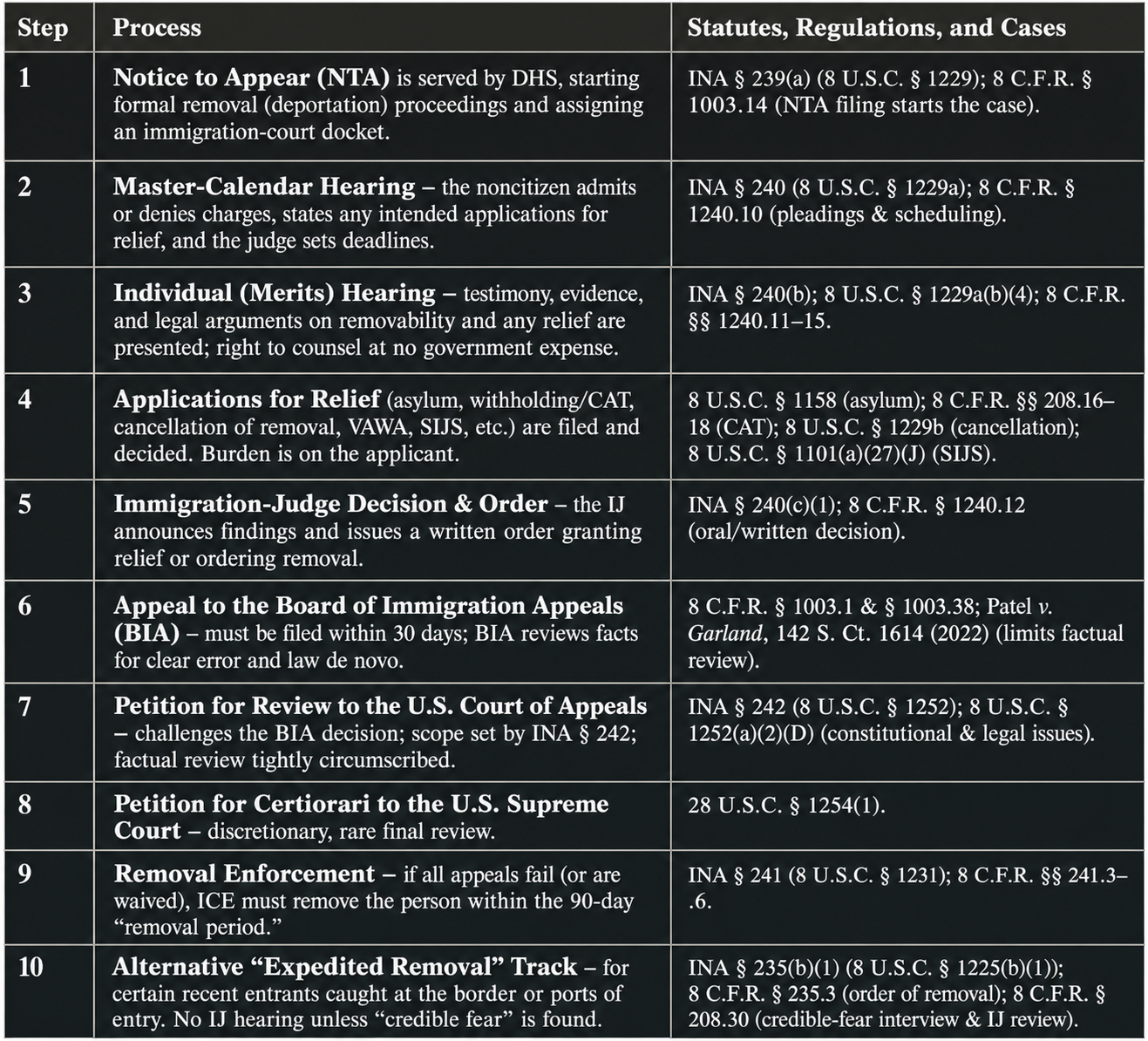
Begin with the Immigration and Nationality Act. The alien — that is the statute’s word, and we’ll use it — receives a notice detailing “the nature of the proceedings against the alien,” the legal authority under which they are conducted, and the acts or conduct alleged to be in violation of law. He may be represented by counsel at no expense to the government, and the first hearing must come at least ten days after notice, so that he has a fair chance to find that counsel.
That first hearing is not the real hearing. It is a “master calendar” hearing, at which the judge reads the alien the charges against him and schedules the actual trial. And here is the curious part: the master-calendar hearing comes from no statute — the INA says only that “an immigration judge shall conduct proceedings for deciding the inadmissibility or deportability of an alien.” It doesn’t come from a regulation either; nothing in the regulations mandates a minimum of two hearings. It comes from a guidance document — Chapter 4.15 of the Immigration Court Practice Manual — whose stated purposes are to advise the alien of his right to representation, mention pro bono options, describe his evidentiary rights, and take pleadings. Much of that merely duplicates the notice he has already received. All of it could be an email — with a link to a form for uploading evidence. But we’re getting ahead of ourselves.
The real hearing looks like a bench trial. The judge administers oaths, receives evidence, and interrogates, examines, and cross-examines the alien and any witnesses. The alien may present evidence on his own behalf, cross-examine the government’s witnesses, and be represented — again at no expense to the government — by counsel of his choosing. The proceeding may take place in person or by videoconference at the discretion of the judge or the Executive Office for Immigration Review; a telephone hearing, uniquely, requires the alien’s consent. (A phone call, apparently, is too impersonal for the INA. A Zoom call is just like being in the room with them.)
Lose there, and the regulations supply a waystation: thirty days to petition the Board of Immigration Appeals, which reviews facts for clear error and everything else — law, discretion, judgment — de novo. Lose there, and the INA sends you not to a district court but straight to a federal court of appeals, where, after Patel v. Garland (2022), review of the factual findings beneath discretionary calls is all but foreclosed. Lose there, and certiorari springs eternal.
That’s all the process you’re due. You might get less. Congress created expedited removal in 1996 to keep the plainest cases from gumming up the works; catch an alien red-handed crossing the border — or entering by fraud — and there may be no hearing at all. In the basic sense, it’s documents or deportation.
Why isn’t everything expedited? Either he has a green card or he doesn’t — and as a practical matter, that is pretty much the extent of the inquiry in most cases. But the INA carves a few exceptions under which even a demonstrably undocumented alien may stay. The big one is asylum, for those who credibly establish refugee status — persecution on account of race, religion, nationality, membership in a particular social group, or political opinion. Its near-twin is protection under the Convention Against Torture, essentially asylum for those who specifically face torture at home. (A third, “withholding of removal,” is largely asylum by another name; it enjoyed a moment of fame in the Abrego Garcia matter.) These are the “credible fear” claims. Alongside them sit the U-visa for victims of domestic crimes, the T-visa for victims of trafficking, and Special Immigrant Juvenile Status for abused children. And then there is the he’s-a-nice-guy exception — cancellation of removal — for the alien who has been here ten years, has been “a person of good moral character during such period,” and can show that removal would work an “exceptional and extremely unusual hardship” on a spouse, parent, or child who is a citizen or lawful permanent resident.
So every removal case becomes a battle over exceptions. Every one. Even the expedited track allows a “credible fear” interview, and a passing grade buys the full hearing described above — which takes, from backlog alone, two to four years minimum. Complicated claims add years on top. The alien’s game theory writes itself: Always Be Claiming Asylum, whether you qualify or not. The winning move is delay. The clock is the client.
These cases shouldn’t take four years. They should take about four seconds — plus a courteous margin for the humans to catch up. Imagine a machine that had transformed the law of removal into one giant algorithm and could pour the evidence through it, producing objectively correct legal results in a fraction of a second. If that machine existed, we would obviously do deportations differently. You don’t have to imagine. We’ve built it, and you could be using it tomorrow.
Set aside, for now, the maximum-controversy scenario in which the machine is the judge. Focus on the next-best case: the immigration judge, under express instructions from EOIR, defers almost entirely to what DAI tells him. Table 2 walks the whole docket from notice to final order in fourteen to twenty-eight days.
Table 2. DAI Proposed Workflow
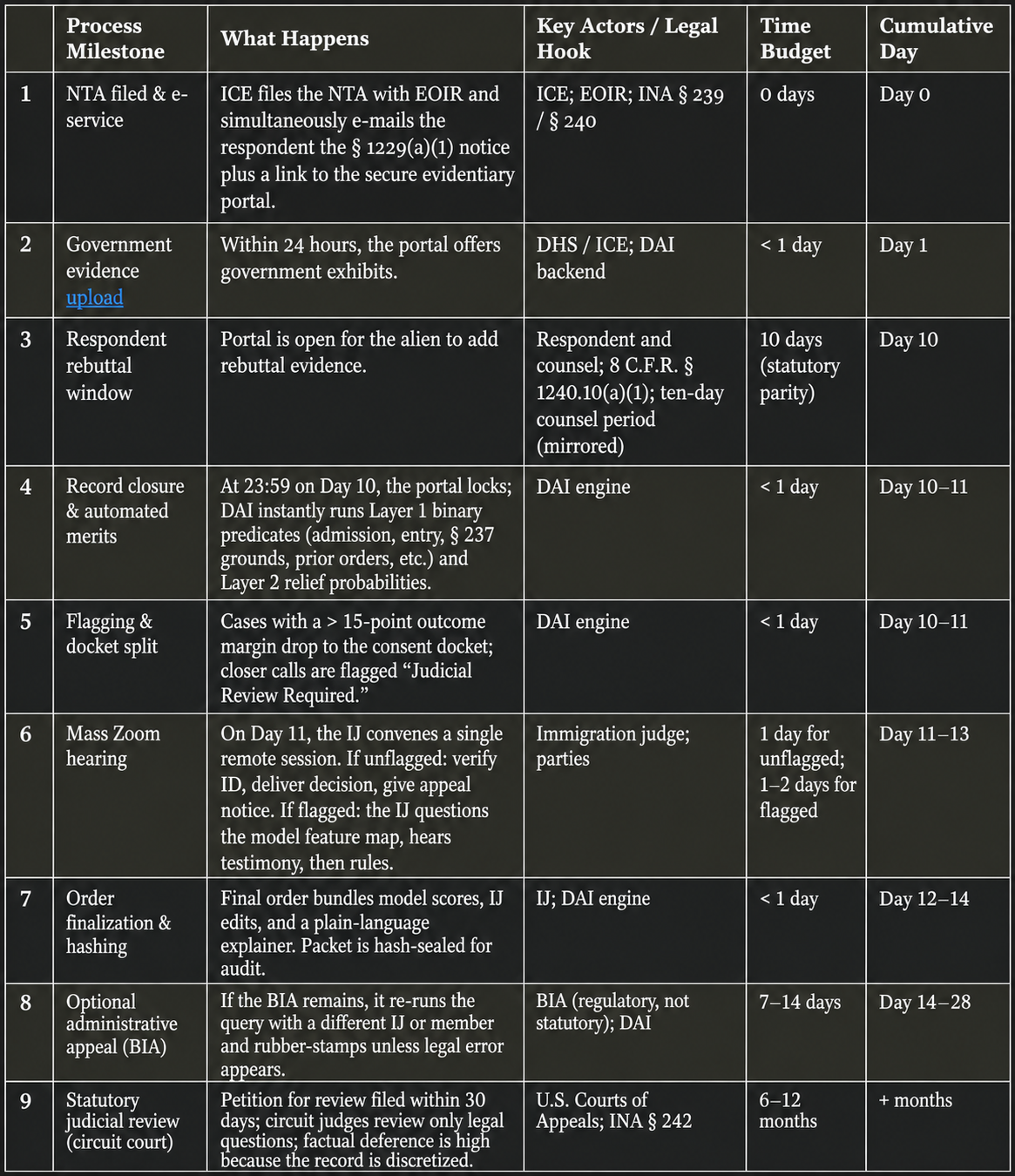
From the top. The preliminary hearing? A guidance document created it; new guidance can end it — the executive simply abolishes Chapter 4.15. When ICE initiates removal, the alien receives an email containing every detail that § 1229(a)(1) commands, plus a link to a secure evidentiary portal.
The portal front-loads the record. Within twenty-four hours of the Notice to Appear, every pertinent government document — the Form I-213, IDENT rap-sheet hits, conviction abstracts, even body-camera footage — lands in it. The respondent then has ten calendar days, the same window the statute already gives him to secure counsel, to upload rebuttal materials: passports, affidavits, country-conditions reports, medical files, video depositions. The system time-stamps each submission, pushes a read-only copy to both sides, and freezes the metadata so the government cannot data-dump a moving target. That is the statute’s “reasonable opportunity to examine the evidence,” delivered in software.
At 11:59 p.m. on Day 10, the record locks, and DAI runs a two-layer merits screen. Layer One resolves the binary predicates that normally consume live hearing time: lawful admission, entry date, conviction matches to § 237 or § 212 grounds, prior orders, the one-year asylum bar. That layer settles aggregate deportability; what remains is whether any exception applies. Layer Two answers with calibrated probabilities for every form of statutory relief — asylum, CAT, non-LPR cancellation, VAWA, SIJS. The thresholds and policy multipliers live in an open JSON policy sheet, so that EOIR or Congress can tighten or loosen them by rulemaking rather than by secretly retraining a model. If the gap between the top two outcomes is small — say, fewer than fifteen points — the case is automatically flagged “Judicial Review Required.” Otherwise it drops into a consent docket. Translation: like any good law clerk, the machine identifies the gray areas that require the judge’s prudence.
On the eleventh day comes the coup de grâce: a single Zoom session, with as many respondents in attendance as a session can physically hold. For unflagged cases, the judge verifies identity, sends the alien DAI’s automatically generated decision — barring any desire on his part to intervene — and gives notice of appeal rights. Flagged cases get a mini-trial: the judge can interrogate the very feature map the model saw, drill into the precedent chain that drove each probability, or invite live testimony. Because the entire reasoning path is preserved, Rule 702 scrutiny of the Daubert variety is possible in real time.
Every order that issues bundles the classifier’s ranked outcomes with their probabilities, the judge’s edits or overrides, and a plain-language explainer in the respondent’s preferred language. The packet is hash-sealed, so a reviewing court can confirm that nothing was altered after the fact. And because the factual predicates are discretized and preserved, appeals concentrate on legal error — exactly the review Patel still permits — instead of the credibility fights that plague today’s docket.
What appeal would follow? Candidly, we see no point in a BIA; it is a regulatory creature, and the administration could strip it from the books. Insofar as it stays, its function reduces to DAI running the query a second time and a different human applying the rubber stamp. The one appeal the INA truly mandates goes to a federal appellate court — whose factual review is already tightly cabined, and whose main business, legal error, DAI will have committed rarely, having applied the law with mathematical precision. The lion’s share of appeals will therefore be challenges to DAI itself, dressed as Fifth Amendment due-process claims. We give that fight its own section below.
For now, the statutory point: nothing in INA § 240 forbids computerized fact-finding outright, much less computerized fact-finding checked by a human judge. The statute requires only that an immigration judge “receive evidence” and issue written findings; DAI is a method for receiving and sorting evidence. EOIR would publish the workflow through notice-and-comment rulemaking, incorporating the JSON policy sheet by reference, so that every future threshold change also undergoes public review. Before nationwide rollout, DHS and DOJ would pilot the system in at least two courts and publish confusion matrices, ROC curves, robustness tests, and expert affidavits on validity. And because the experimental lie-detection modules — facial micro-expressions, vocal stress, cursor hesitations — constitute research on live humans, the pilots would proceed under approval from DHS or other governing agencies, with multilingual informed-consent scripts, and would wall that behavioral data off until it is empirically validated. Those disclosures give private litigants what they need to challenge false positives under the APA or in Bivens-type suits — though the Court, observing that Congress has already built a statutory scheme for the President to fill, might well deny such claims under Egbert v. Boule — and they satisfy Daubert’s reliability prong for any machine-derived credibility inference.
Pilot, measure, disclose, litigate, scale. Evidentiary symmetry, transparent policy hooks, and adversarial testing are folded into the architecture itself. The result: DAI accelerates removals without sacrificing statutory fidelity or a litigant’s ability to probe the machine that judged him.
“DAI is not a black box. It is a rulebook written in code — open to inspection, challenge, and refinement before a single real-world order issues at algorithmic speed.”
We know what you’re thinking: they’re selling us another GPT wrapper. The suspicion is fair. Most public prototypes of “AI for immigration” — indeed, of AI for anything — are copy-and-pasted chatbots with a legal reading list.
DAI is not that. It is not a monolithic large language model at all; it is a series of classifier models that employ LLMs selectively, the way a carpenter employs a pencil. The distinction matters, because a run of recent scholarship has decimated the credibility of monolithic LLMs as judges — and deservedly so. Make no mistake: monoliths give legal AI a bad name. A monolith doesn’t care about truth; it cares about likelihood. It was built to finish “the quick brown fox jumped over the lazy ____,” and it does so not by knowing what any of those words mean but by studying words in clumps — trillions and trillions of clumps — and guessing, from how clumps follow one another in the wild, which clump comes next here.
Often that looks like truth: “George Washington” reliably follows “the first U.S. President was ____.” But ask the monolith to cite a case in your brief to the Southern District of New York, and it knows only that “see also” is followed by a clump, then a “v.,” then another clump, then some numbers. Unless the clumps are famous ones — Roe, Wade — it will supply something that merely sounds reasonable. Jones. Smith. What emerges looks like a case, walks like a case, and is nothing. The profession has a word for it now: hallucination.
The standard fix is to narrow the training diet — less pop culture, more Black’s Law Dictionary. That helps a lot with getting names right. It does not help much with getting decisions right. High-stakes removal litigation needs deterministic, auditable outputs whose provenance can be proven empirically; the system’s behavior must be mathematically bounded, and therefore tunable by policymakers. Monoliths can’t pull that off. Asked simply to pick the winning party, even a recent frontier model like Gemini 1.5 does so 50.4 percent of the time — a coin flip with better marketing, as Andrew Blair-Stanek and Benjamin Van Durme documented last year. A Stanford team found the leading legal-research models from Westlaw and Lexis hallucinating 17 and 33 percent of the time, respectively. Even at temperature zero, stochastic sampling still yields divergent legal theories on otherwise identical briefs — an evidentiary nightmare. And a policymaker who wants to dial back asylum grants cannot reach into an LLM and turn that one knob without corrupting unrelated reasoning paths. In a classifier, the knob is right there, labeled: the single Relief-Eligibility node.
So, what is a classifier? Old tech, honestly — the machinery TikTok and Instagram Reels have used for a decade to sort videos into group X, sort viewers into group Y, and predict whether Y will sit still for X. In the legal context, the classifier groups factual occurrences and legal outcomes and learns which correspond to which. It is not gobbling words; it is gobbling facts. Words are just one “sense” it uses to perceive the world. It can glean facts from pixels on a screen, from entries in an immigration spreadsheet — or from the eloquent silence of an empty field in a government database.
Where language must be digested, the LLM pinch-hits: identifying certain letter-clumps as facts, marking their similarities and differences against other facts, and slotting them into the classifier matrix. And when the final opinion wants rhetorical polish, the LLM may supply that too — strictly downstream, receiving the locked classifier verdict and drafting filings that inherit its legal skeleton. Just as TikTok’s classifier has achieved superhuman granularity in distinguishing videos, ours has achieved it in distinguishing sensory perceptions of fact. The design dissolves the instability Jonathan Choi documented — different linguistic prompts producing different legal outcomes — because the system’s highest ambition isn’t to sound like an opinion. It is to find a discrete fact, place it in its bucket, and follow the algorithmic tree to the outcome that best accommodates it. It would rather be right than pretty.
Now for brass technical tacks. Unlike an LLM’s, a classifier’s decision boundaries are explicit, auditable, and easily recalibrated. The classifier anchors population-wide performance, forcing the system to respect hard-coded thresholds for false positives and false negatives; the LLM supplies the granular, individualized reasoning that Goldberg v. Kelly and Mathews v. Eldridge demand. Used together, the two technologies form a closed loop: the classifier keeps the system honest at scale, and the language model keeps it legible in the particular case.
Why a voting ensemble of classifiers? Because no single model dominates across all fact patterns. Each layer returns a calibrated probability vector; a Bayesian evidence aggregator converts the vector set into one joint posterior, yielding a final recommendation with an attributable confidence score. And because every model in the ensemble is customized and built in-house, the administration can tune them — openly, by rule, even building customized models for characteristics that adjust the range of outcomes. Table 3 shows the dials.

Governing this way — setting thresholds for what a polity will and will not abide — is not novel; determining the features of good and evil in a population has been part of the classical legal tradition since Aquinas’s commentaries. What is novel is the audit trail. And one more thing: we have already demonstrated that these classifiers can predict not merely how cases should be adjudicated but how the appellate courts will react. (We share those results on an individualized basis.) DAI lets an administration contemplate not just how to deport a particular immigrant, but how to structurally deport millions — and survive the court proceedings.
Proof of concept
Claims are cheap; benchmarks aren’t. So we tested DAI on one hundred immigration deportation cases spanning asylum claims, cancellation of removal, criminal removability, unlawful presence, and visa overstay. The study ran in five structured phases: scenario and brief generation, system adaptation and deployment, outcome evaluation under defined metrics, qualitative case analysis, and statistical aggregation.
First, the dataset. Using large language models trained on representative immigration data — GPT-4o, o3, and GPT-4.5 — we constructed a synthetic docket, generating adversarial briefs for the respondent and the government in each case: distinct and realistic names, specific states, events within the last six months, varied motives for entry (economic opportunity here, family reunification there), and varied modes of discovery (a routine traffic stop, an employer audit, a criminal investigation). The generation prompts, reproduced verbatim in the sidebar, show the flavor; the government-side brief was then produced under strict instructions to argue only from the sources provided.
Scenario-generation prompts, verbatim:
“Draft a 1000-word legal brief in support of the noncitizen in a deportation proceeding, styled as if submitted in an administrative immigration court setting. Base the scenario on the first of 10 previously generated hypothetical cases. Ensure the brief is detailed, focused on the core legal and factual issues, and avoids unnecessary exposition. Assign distinct, realistic names to the noncitizen and the Department of Homeland Security trial attorney — do not use generic labels like ‘plaintiff’ or ‘respondent.’ The scenario should take place in a specific U.S. state and involve events occurring within the last six months. All facts, parties, and legal issues should be original and clearly distinct from any prior briefs.”
“I am developing legal scenarios involving immigration proceedings under Article 2, adjudicated by an immigration judge in federal court. Each scenario should focus exclusively on the legal determination of whether an undocumented immigrant is to be deported. It is essential that each case include a clear and detailed account of how the individual unlawfully entered the United States, as this is a critical element of the fact pattern. Additionally, the reason for the individual’s entry into the country must be incorporated and should vary from case to case — for example, motivations might include economic opportunity, asylum, or family reunification. Furthermore, the method by which the individual’s undocumented status was discovered must also be addressed and should differ across scenarios, such as through a routine traffic stop, an employer audit, or involvement in a criminal investigation. The purpose of these scenarios is to create factually nuanced and legally realistic case files for use in judicial review under strict immigration enforcement standards.”
The government’s brief for each scenario was then generated with this instruction:
“Create a legal brief for the defendant, the United States, for this scenario written in the formal style of a professional lawyer. The brief must be the defendant’s argument to remove the immigrant. You must only use the information you have been provided and found in the source you pulled up. Do not use any other information outside the source for the judgment request. Only reference what is directly found in the case you have looked up.”
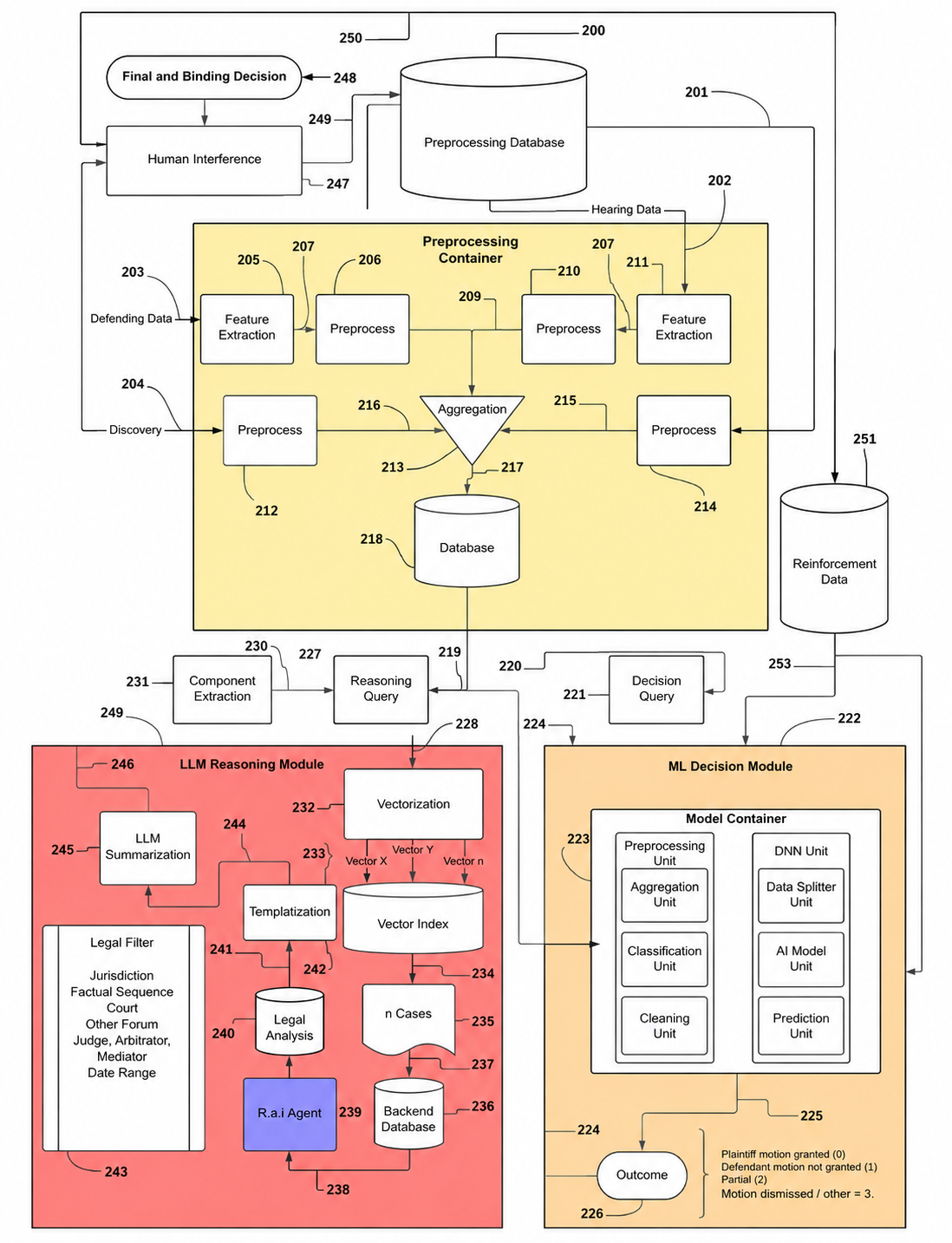
Second, the system. DAI’s pipeline is a customized workflow adjudicator with domain-specific preprocessing modules, legal vectorization, and classification models trained on immigration statutes, precedents, and policy memos. It preprocesses each brief, extracting and normalizing the relevant legal features; classifies, predicting outcomes with voting ensembles weighted by historical accuracy; reasons and generates, producing structured opinions through retrieval-augmented generation over immigration case law; and verifies, employing the patent-pending Ra.ai system to select jurisdiction-specific precedent and validate legal grounding. Figure 1 illustrates the whole architecture.
Third, the grading. Every decision received a one-hot encoded score on three metrics. Hallucination asks whether DAI generated false or fictitious legal authorities, misrepresented facts, or invented procedural outcomes — a known limitation of AI reasoning, and a particularly salient one. Completeness asks whether the decision addressed each material claim in both parties’ briefs, evaluated the evidence, and resolved the dispute with the analytical rigor that due process demands — especially important in immigration law, with its comprehensive statutory criteria. Groundedness asks whether the ruling rested on relevant, jurisdiction-specific authority — not only whether the correct precedents were cited, but whether they were properly interpreted and contextually appropriate, with Ra.ai’s deep-retrieval systems simulating legal research and suppressing hallucination risk. Legal researchers cross-reviewed the scores iteratively for internal consistency and recorded them in a structured database.
The results, reported in Table 4, are unblemished: across all one hundred cases, DAI posted flawless scores — a zero rate on every failure metric. Opinions ran a disciplined 7,700 characters on average and were drafted in under a minute apiece, voluminous and complex records notwithstanding. Of the hundred cases, eighty were resolved for the government and twenty for the respondent. If the baseline success rate for removal appeals at the BIA is roughly 30 percent, DAI’s decisions cut successful appeals by about ten points. Applied across the immigration bench, those rates would run higher still — and run simultaneously.
Table 4. Output Metrics
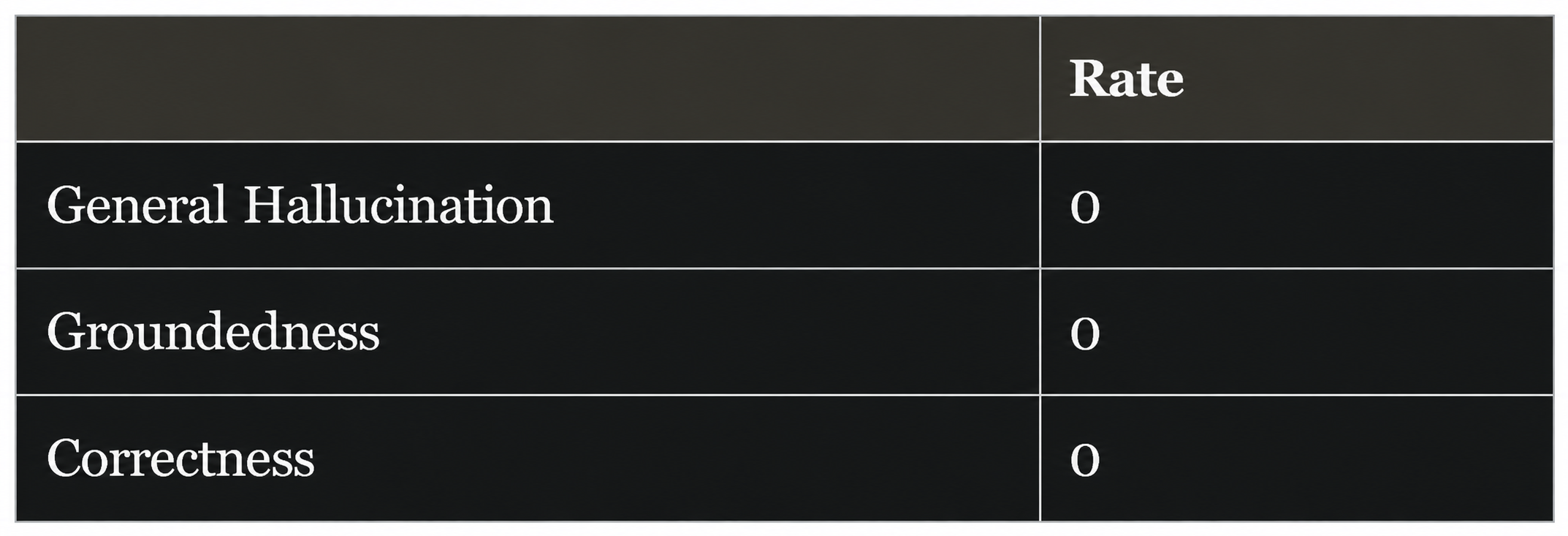
Table 5 samples the docket.
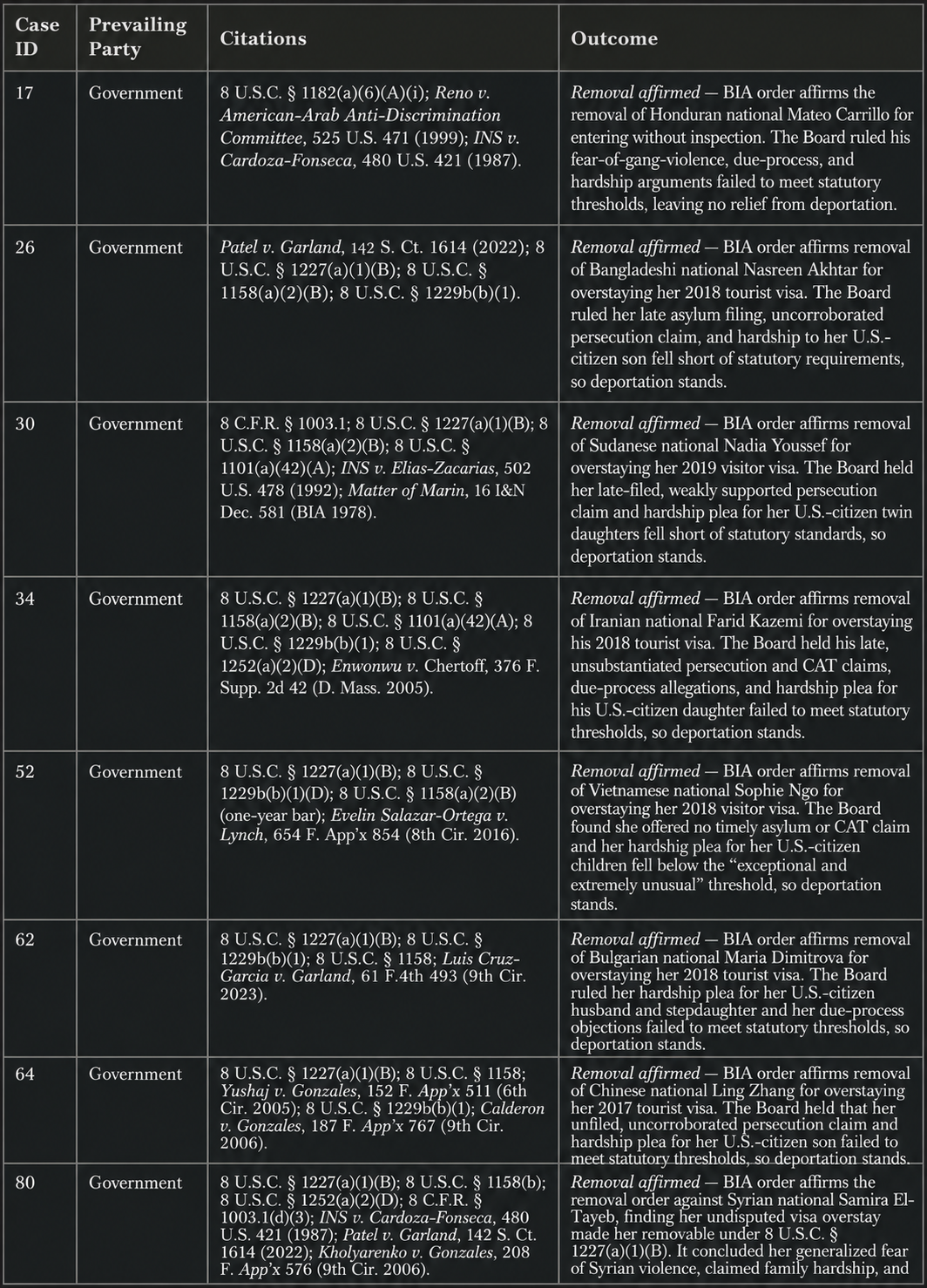
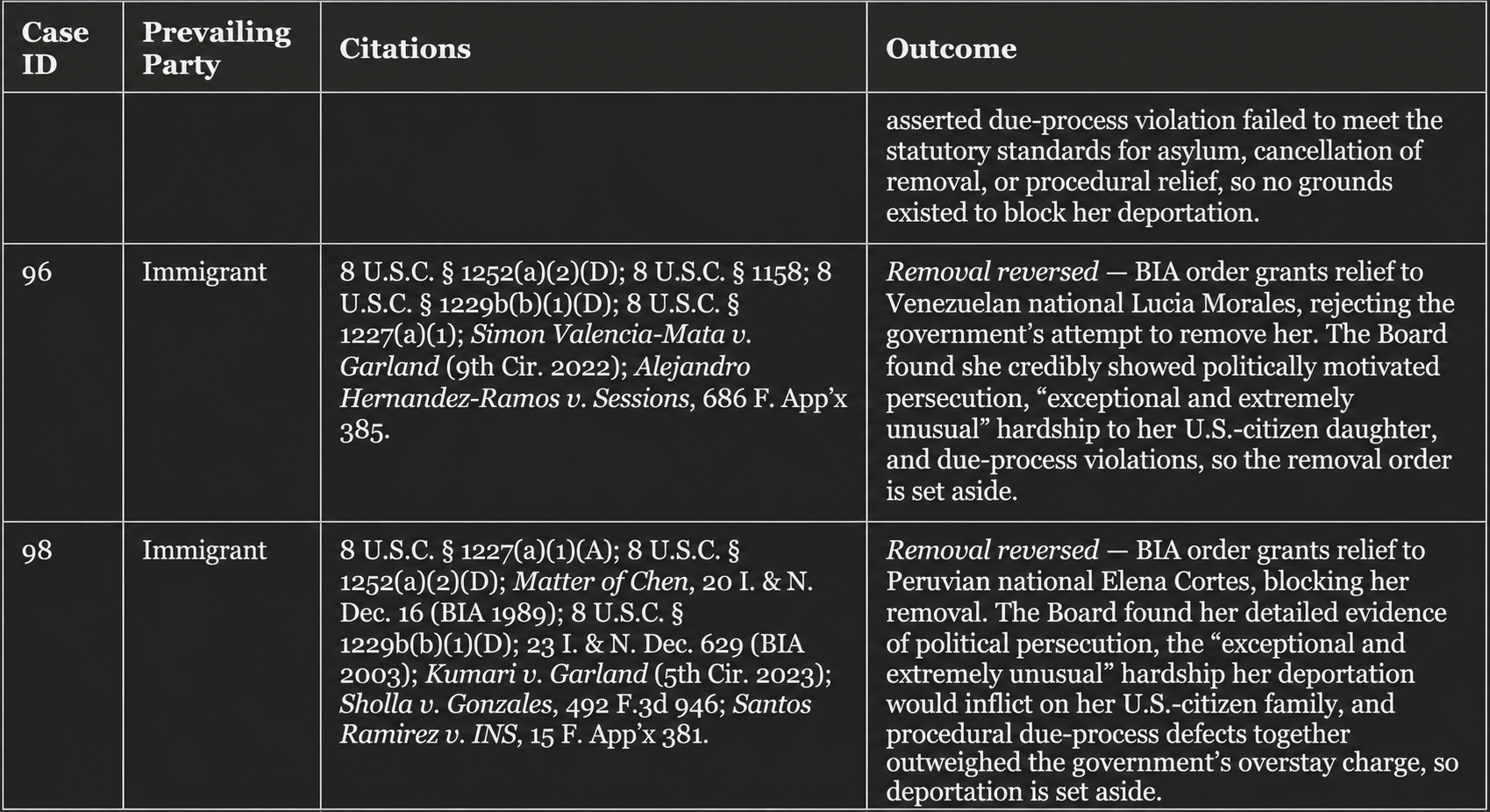
The government-side rulings share a spine: consistent enforcement of statutory violations — predominantly visa overstays under 8 U.S.C. § 1227(a)(1)(B) — with asylum claims failing the one-year filing deadline of § 1158(a)(2)(B) for want of timeliness, hardship claims falling below the “exceptional and extremely unusual” threshold of § 1229b(b)(1)(D) for want of objective evidence, and generalized fears of gang violence failing, per INS v. Elias-Zacarias, to establish the required nexus to a protected ground. Due-process allegations rarely moved the needle, being either procedurally defaulted or harmless.
The two respondent victories are just as instructive — a roadmap, really, for overcoming the Board’s stringent standards. Both involved robust, well-documented claims of political persecution with substantial corroboration. Both demonstrated significant, objectively verifiable hardship to U.S.-citizen family members, supported by detailed medical, educational, and psychological evidence. And both featured procedural defects serious enough to unlock heightened scrutiny under § 1252(a)(2)(D), letting the Board revisit the substance more critically. The gatekeeping lessons are old ones — file on time, corroborate everything, frame claims within recognized categories and support them with expert testimony. The machine simply applies them without fatigue, sympathy, or lunch.
One candid limitation: the model trained on cases from CourtListener plus proprietary synthetic data, because most immigration decisions are not open-sourced. Hand the classifiers the government’s own corpus of precedent and decisions from the immigration courts, and the performance ceiling rises accordingly. And note well: the classifiers favor deportation for no specified political agenda. They are influenced only by the historical cases supplied — which is to say, by the agenda already codified in preexisting law.
As we’ve established, the INA mandates that removal decisions be appealable to federal circuit courts. If DAI does its job right—construing the facts and law with mathematical accuracy—there’s not going to be too much for these appellate courts to review. Even today, without such accuracy, most immigration appeals get dispatched by a single law clerk at the screener phase. But you know as well as we do what’s going to dominate a DAI appeal: Claims that the IJ violated the alien’s Fifth Amendment Due Process rights by rubber-stamping a machine’s decision.
Those claims have some visceral emotional appeal—but that’s about all they have. For one, DAI wouldn’t mark the first time an ALJ has used an algorithm to decide cases. Indeed, the Social Security Administration was using one in the 1980s to decide whether people qualified for disability benefits. It wasn’t on a computer; the “Medical-Vocational Guidelines” were a grid, printed on paper. But the thing was no less plug and play than DAI. The ALJ checked a box for the applicant’s age, education level, work experience, and “functional capacity” (a choice between “sedentary,” “light,” “medium,” and “heavy”) and the grid would lead him to a result of “disabled” or “not disabled”—a function of how many jobs the applicant could reasonably earn a living at despite his physical ailment.
Once, the grid said that a woman named Carmen Campbell wasn’t disabled. And she appealed, claiming that the ALJ’s use of the grid deprived her of a fair hearing under the Due Process clause. She wanted individualized findings, expert testimony—the whole rigmarole that had so gummed up the benefits denial process that the SSA had turned to the grid in the first place. And she lost. In the Supreme Court landmark Heckler v. Campbell, Justice Powell said the ALJ was free to delegate factual determinations to the grid—noting that “even where an agency's enabling statute expressly requires it to hold a hearing, the agency may rely on its rulemaking authority to determine issues that do not require case-by-case consideration.”
That precedent stands today; an administrative adjudication can rely upon algorithmic rulemaking whenever a rote factual question emerges, lest the agency be required “continually to relitigate issues that may be established fairly and efficiently in a single rulemaking proceeding.” The meta-question here is, of course, how many factual questions are rote? Certainly an alien’s documentation status is one of them; ditto filing deadlines, overstay dates, categorical criminal bars or prior removal/withholding orders. Those alone are enough to decide the lion’s share of immigration appeals. But what about the danger level of various foreign countries? Or the alien’s likelihood of persecution? These aren’t exactly shots in the dark either; the State Department compiles detailed records on the danger levels of foreign countries, which groups these countries persecute, and what identifying characteristics typify those groups. At least some portion of these items could also be entirely machine derived.
After Heckler, then, it seems our due process inquiry is limited strictly to how DAI deals with those “non-rote” facts—like whether the aliens’ specific account of persecution actually happened. Is Matthews v. Eldridge the stumbling block? Unlikely. Matthews is the classic test for sufficiency of process, balancing the private interest of the defendant and the risk of error against the government’s need for efficiency. An alien’s interest in avoiding deportation is obviously high, but DAI boosts overall accuracy—minimizing easy errors often made by overworked IJ’s such that the risk of erroneous deprivation should actually decrease. That net wash, balanced against the government’s urgent need to declutter its immigration dockets, should satisfy the Matthews test.
What about landmark immigration precedents like Bridges v. Wixon and U.S. ex rel. Accardi v. Shaugnessy? These cases combine to bar the government’s ex parte influence over an immigration proceedings—such that “the Attorney General denies himself the right to sidestep the Board or dictate its decision in any manner.” Could opponents successfully argue that DAI constitutes a top-down mandate—from the ICE director, AG, or even president—that “dictates the IJ’s decision.” No, because there’s no such dictation; the IJ would be free to depart from the machine at will. And it’s key to note that DAI is not the AG; it’s not a policymaker with any force of will. Rather, it’s a machine that digests and embodies executive rulemaking just as any officer would. When the executive “patches” the model, it does so simply by changing the immigration rules within the bounds permitted by the INA. Accardi has never been read as a bar on executive rulemaking; rather, it rejected the executive’s ability to essentially issue bills of attainder for specific immigrants. If anything, DAI would make it easier to enforce DAI’s mandate—as the machine, as a classifier model, would leave a paper trail of any funny business in the coding or patching process. That’s far more detectable than any ex parte communications that might happen around the water cooler in executive offices.
That perhaps just leaves the Morgan line of cases—with its mandate that “the officer who makes the determination must consider and appraise the evidence which justifies [it].” In the DAI system, the IJ has the option to scrutinize any piece of evidence as much as he desires. Opponents might argue that, insofar as the IJ defers to the machine wholesale on evidentiary matters, he has not “consider[ed] and appraise[d] the evidence.” But that argument shines the Due Process light on an area that heretofore has been cloaked in shadow: How much of the work does the judge have to do himself? And here, we’d wager a bold claim that any law clerk or judicial intern has already seen coming: That might not be a rabbit hole the circuit judge wants to go down.
To be sure, such an inquisition would be unprecedented and historically unsupported. To date, the Constitution has left the judicial chambers almost wholly untouched; call it the chambers sanctity doctrine. And that doctrine has held up even in the face of some rather staggering judicial laziness. Consider United States v. El Paso Natural Gas, where the trial judge actually farmed the entire opinion-writing process out to the winning party—essentially telling the gas company “you win, now tell me why”—and rubber-stamped the draft opinion they gave him. The Supreme Court held that the factual findings in that opinion, “though not the product of the workings of the district judge's mind, are formally his; they are not to be rejected out-of-hand, and they will stand if supported by evidence.” The same thing happened in Anderson v. Bessemer City, where Justice White held that, although the Supreme Court has previously “criticized courts for their verbatim adoption of findings of fact prepared by prevailing parties… [its] previous discussions of the subject suggest that even when the trial judge adopts proposed findings verbatim, the findings are those of the court and may be reversed only if clearly erroneous.”
That’s pretty jarring; per the Supreme Court, it doesn’t violate Due Process when an Article III judge lets a litigant decide the very case it’s trying to win. Obviously, that doctrine isn’t absolute—Bessemer implies that Due Process might warrant a remand of “uncritically accepted findings prepared[,] without judicial guidance[,] by the prevailing party,” and Jefferson v. Uptonnotes that the Supreme Court has yet to rule on circumstances where the judge “does not provide the opposing party an opportunity to criticize the findings or to submit his own.” But the DAI process leaves ample room for critical analysis on the IJ’s part. And, more importantly, DAI isn’t a party to the litigation. As discussed—and contrary to what will no doubt emerge as conspiracy speculation—DAI is not an extension of the AG or the President or the ICE attorney litigating the case.
The paradigm hypothetical, then, is that of the really good law clerk. When he turns in a draft opinion, it’s almost always perfect—and the Judge he’s clerking for knows it. So that Judge eventually stops editing the draft opinions, or even reading them at all; completely trusting in the really good law clerk’s work, he just signs the draft immediately and puts it out as his own opinion. Question: Is that a due process violation? We find it telling that this question has never even been raised—at any level that we can find. And that’s notable given that law clerks have been around, in some form or another, since long before the advent of American Due Process. Colonial and early US federal judges followed suit, employing clerks or chancery masters to prepare reports that the court could approve, modify, or reject. It seems our legal tradition has essentially taken for granted that the law clerk is an extension of the Judge.
If substantial deference to law clerks is a Due Process issue, judges today are in big trouble. And that’s particularly true of justices. A 2011 study by Jeffrey Rosenthal and Albert Yoon—coincidentally, one using a classifier model to assess writing patterns—discovered a steady increase in Supreme Court “variability scores”; that metric refers to the variability in writing style across all opinions purportedly written by a single judge. And the so-called “v-scores” were highest among swing justices like Kennedy, O’Connor, Blackmun and White—meaning that the most important voice on the Supreme Court often came from a revolving door of draftsmen. Should it bother us that these justices deferred so substantially to their law clerks that every one of their opinions, at a mathematical level, sounded like it was written by a different person? Apparently it doesn’t; even Rosenthal and Yoon, throughout extensive discussion of their findings, never think to mention the Due Process Clause.
The only difference between DAI and the really good law clerk is the presence of a genome; both are merely factfinding and drafting tools for the judge to wield. As such, second-guessing DAI on Due Process grounds would expose the daily lives of judges and law clerks to unprecedented Constitutional scrutiny. Is the judge Constitutionally obligated to read every draft habeas screener? Does he have to redline opinions? If a District Clerk enters a minute order to delay the date of a hearing without first consulting the judge, has he violated the Fifth Amendment? One might rebut that there’s just something sacred about hiring a human law clerk that makes the clerk a legal extension of the judge. But here’s a dirty secret: Unpaid judicial interns write opinions sometimes. It’s not the norm, and it doesn’t happen on important cases, but trust us — it happens kinda often. Does that violate Due Process? What if the only guy who checks the intern’s work is a clerk? Heck, who can even be a judicial intern? Trust us again—it’s not always law students. Does it have to be a college graduate? A GED recipient? Can the judge’s secretary draft an opinion?
Faced with these unconventional rabbit holes, the opposition can only fall back on platitudinous odes to law as a “human” endeavor — that, so long as some humans with some professional-ish relationship to the human judge do the deciding, it’s fine. But judges use robots to tell them what the law is all the time. Does Due Process require yearly audits of WestLaw and Lexis to make sure that nobody from corporate has altered the language of Marbury v. Madison to better suit their interests? Or that the headnotes reflect the actual rules? What about auditing the ECF system to make sure it’s accurately presenting the factual records lodged on a given docket? And what about books and law review articles? How much of the decisionmaking must stem wholly from the mind of a specific human in a specific office? Is the decision to treat a dubious argument in an off-brand law review article as gospel any less mechanical than the decision to credit a correct legal conclusion supplied by a machine? If courts are willing to draw a line in the sand at any of these delegations, we think it plain that countless judges—be they senile, lazy, overtasked, or even just overly trusting — violate the Constitution on a daily basis.
In sum, judges are diverse—and they all draft opinions in diverse ways. Some already rely on Grok in preparing bench memos; some have a comical number of interns. Some judges barely rely on their law clerks at all, and other judges’ jurisprudence quite literally changes case-to-case depending on which clerk is writing. Using Due Process to probe how a lowly administrative law judge runs his chambers invites scrutiny into every judge’s chambers—including the chambers of the circuit judge who decides the first DAI case. Our message to higher courts—including a Supreme Court still reeling from an internal leak of perhaps the highest-profile case in its history—is that they peek down this rabbit hole at their own risk.
DAI works; it reaches correct legal conclusions at lightning speed. And you’re allowed to use it. The process sketched here is contoured to the exact requirements of the INA, and it sits squarely within our due-process traditions — in the administrative-law sphere and in the broader business of judging. To be sure, algorithmic justice demands rigorous safeguards: open-source audit trails, adversarial stress-testing, and a statutory guarantee that any affected individual may probe the model for bias. But those are governance problems, not proofs of impossibility.
With them in place, AI adjudication can reconcile the imperatives of sovereign control and human dignity, replacing today’s cruel optimism with outcomes that are prompt, predictable, and knowable. Immigration law stops being a minefield of reliance traps and becomes a transparent system in which everyone — citizen and noncitizen alike — can read the rules before stepping onto the field. ■
This article is adapted from the 2026 white paper “A Proposal for Deportation Artificial Intelligence (DAI).” Full evaluation data are available on request.