
American Intelligence
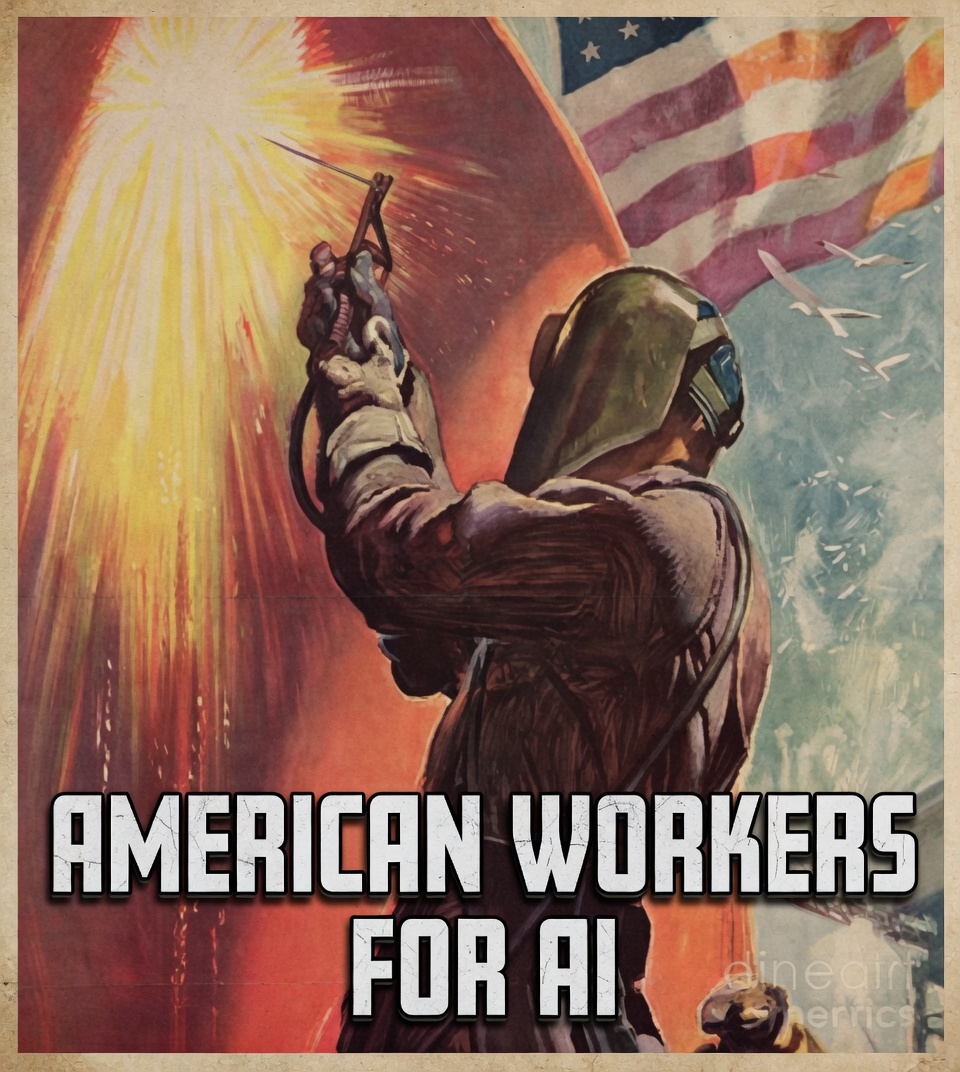
American workers are poised to win big as the AI labs race to train larger and more powerful models. But to maximize their gains, they need an economic policy approach that remains open to the development of computing infrastructure and enables them to participate.
Software has traditionally served as a substitute for activities in the physical world. Optimized supply chains mean less labor-intensive logistics. The ability to order a product from the internet means retail requires a smaller physical footprint.
AI models are different. They’re more computationally costly to develop and run than traditional software, and they depend heavily on physical infrastructure. To name a few examples: data centers, cooling systems, electrical substations, power lines, and all of the inputs to those things.
In other words, compared to traditional software, AI is less of a substitute for the skills that drive activity in the physical world and more of a complement. It stimulates demand for many types of workers.
Gusto, a maker of payroll management software, released data in February showing that workers in multiple construction trades earn considerably more in geographical data center hotspots. Plumbers, pipefitters, and steamfitters in particular command a heavy wage premium, earning over 20% more than their peers who aren’t located near data center construction.
According to Fortune, data center-related construction wages can be up to 30% higher than those associated with other types of construction.
These gains aren’t limited to incumbent firms or experienced workers. The high-demand environment that drives these wage increases also opens up opportunities for younger workers and those looking to make a career transition.
The International Brotherhood of Electrical Workers wrote in a 2025 blog post that some of its locals needed as many as four times their current membership to meet the demands of individual data center projects.
“We’ve experienced a lot of increased demand for workers. We need to grow our local and figure out some strategies to accomplish that,” the business manager for one local was quoted as saying.
In Mississippi, the state’s economic development office has partnered with community colleges and Amazon to create a paid pre-apprenticeship program designed to prepare students for jobs related to computing infrastructure, such as fiber splice technicians.
The urgency to position local workers to participate in the AI boom comes on the back of a major spending spree on the part of Amazon and xAI. Each of these companies has committed to invest ten figure sums in data centers and energy infrastructure in Mississippi.
But the very quality that makes AI a driver of opportunity — its reliance on physical infrastructure — also makes it more politically vulnerable than the world of bits historically has been.
Senator Bernie Sanders and Representative Alexandria Ocasio-Cortez introduced a bill in March banning the construction of new data centers. Though that legislation is unlikely to pass and has even drawn the scorn of more moderate Democrats, the same battle is playing out on a local basis around the country.
Data centers proposals have frequently faced opposition not just from locals but also from environmental and social justice groups, whose involvement is well documented but rarely central to media narratives about local battles.
Though the political left has traditionally positioned itself as the champion of labor interests, the modern left has divided its attention in pursuit of other policy goals. An essay by Andrea Crooms, a former Prince George County environmental official and Democratic Socialists of America member, is shockingly honest on this point.
The author argues that workers’ desire for a robust labor market exists in tension with other left-wing priorities, such as “environmental justice” and the concerns of “climate activists, Indigenous communities, and other social movements.”
This is correct. It isn’t possible to maximize wage and job growth while satisfying every constituency that objects to job-creating projects. If the political right wants to enrich American workers and the political left asks them to compete with ten other conflicting priorities, it’s clear which side offers the better bargain for labor.
While the public has concerns about AI, there are political opportunities on the jobs front and tried-and-true models for seizing them at both the federal and state levels.
In March, the White House released its National Policy Framework for AI. The framework was designed to guide legislative efforts to codify the administration’s friendly posture toward AI into law.
Of particular importance are state regulatory preemption, designed to create a consistent set of rules fit for the national scope of AI developers’ operations, and rate-payer protection, meant to ensure AI firms cover the cost of new electrical infrastructure to protect consumers from rate hikes.
The first proposal seeks to protect the burgeoning industry from overzealous state regulators and the second — in addition to addressing the direct concerns about equity and affordability — may come to mitigate anti-data center sentiment and ward off more overreaching proposals.
The framework also calls for expedited permitting for the energy infrastructure data centers rely on and for aligning federally-funded education and training programs with the needs of an AI-enabled workforce
At the state level, Mississippi offers a proven model for developing computing infrastructure. Mississippi’s Major Economic Impact Act framework gives the state government power to assemble incentives packages and align stakeholders to enable large investments in the state.
Incentives can include state infrastructure support and — critically — workforce development. In the case of the MEIA package that lured Amazon to Madison County, the vast majority of the state’s $44 million dollar appropriation went toward training programs like the one discussed earlier.
Cooperation with builders, regulatory restraint, and incentives offered by states seeking to court development can ensure workers have access to a steady stream of projects to which to apply their skills.
For at least a decade now, commentators on the political right have called for the reindustrialization of America, for putting our people to work building things in the real world. Now the digital and physical economies are converging, and the time has come to forge a worker-centered coalition focused on development and opportunity.
Any movement that enabled American workers to thrive under the coming economic paradigm would dominate the era.