
American Intelligence
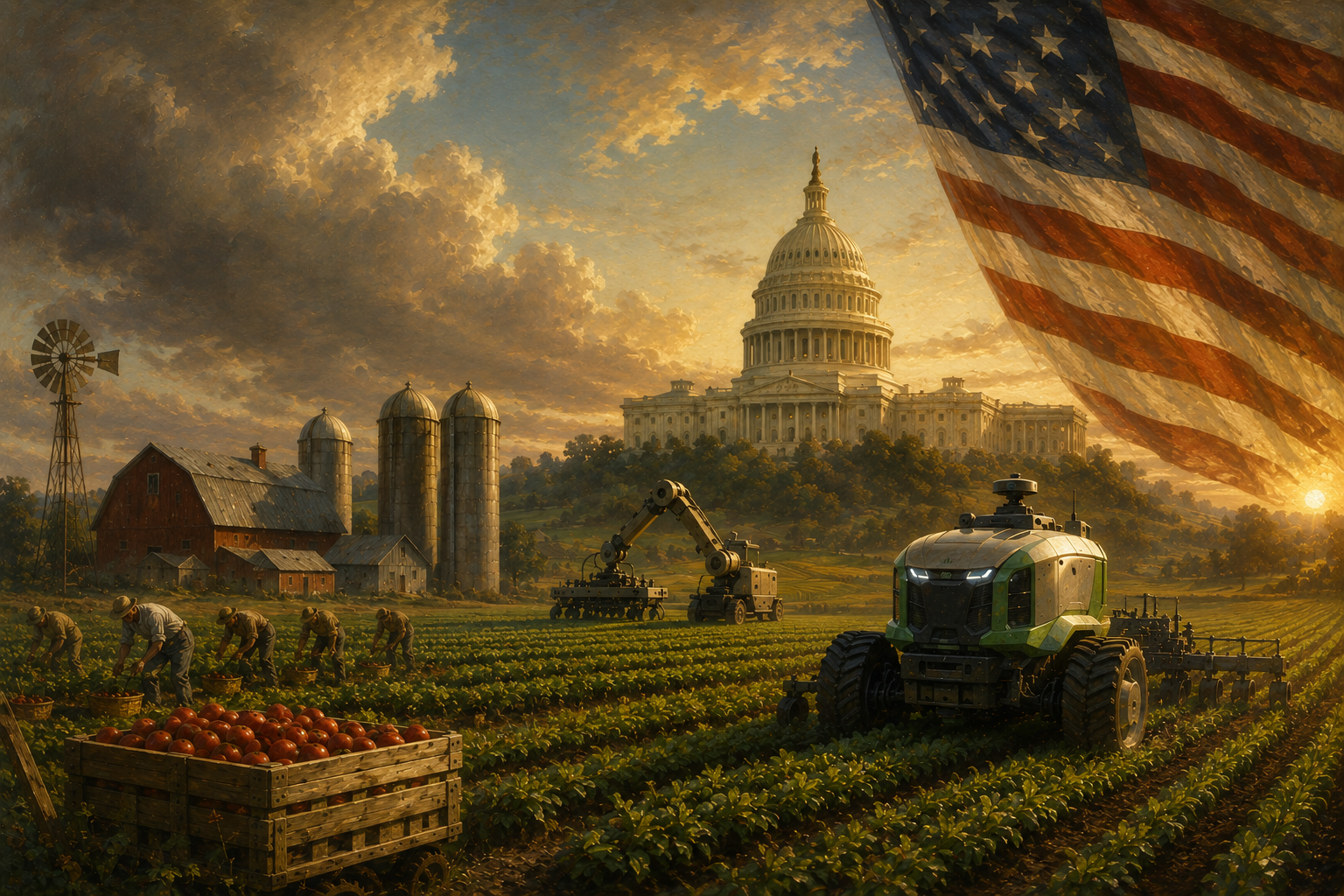
For nearly four decades, Washington has returned to the same agricultural-labor question: where will the next worker come from?
Congress has argued over guest-worker visas, immigration enforcement, wage rules, legalization proposals, and employer sanctions. Across nearly every proposal the underlying premise rarely change: American agriculture will continue to require a large supply of foreign labor, and Washington's task is to decide how that labor should be supplied.19
Some proposals expand temporary visas. Others legalize workers already here. Still others pair stricter enforcement with a lawful seasonal-worker channel. Nearly all treat the amount of labor farms require as fixed.
Before asking where tomorrow's farmworkers will come from, policymakers should ask how many workers tomorrow's agriculture should require.
That assumption made more sense when labor-intensive tasks had few practical mechanical substitutes. It makes less sense today. Artificial intelligence guides crop decisions. Machine vision distinguishes weeds from crops. Autonomous equipment navigates fields. Robotic milking systems operate around the clock. Automated sorting and packing systems perform work once assigned to large crews.
Technology has not solved every agricultural labor problem. Delicate fresh-market crops remain difficult to harvest mechanically, and many farms will continue to need experienced workers. But for a growing share of tasks, the limiting question is no longer whether the technology exists. It is whether producers can afford to adopt it.
Public policy has been slow to recognize that change. Washington still treats the agricultural labor debate primarily as an immigration problem: How many H-2A positions should be available? How quickly should unauthorized workers be removed? Should employers face stronger penalties? Should Congress legalize workers already in the country?
Those questions matter. But they only address the supply aspect. Far less attention has gone to the capital investments that could permanently reduce demand for foreign labor.
When recurring labor remains comparatively accessible while automation requires a large, difficult-to-finance upfront investment, producers respond rationally: they keep buying labor instead of machinery. The constraint is often financial before it is technological.
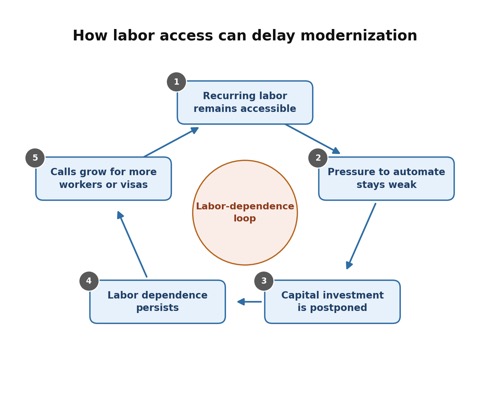
Predictably, we see a self-reinforcing cycle. Labor shortages generate calls for more visas. Illegal employment generates calls for stronger enforcement. Producers warn that crops will go unharvested. Congress returns to labor supply, while technologies that could reduce labor demand remain at the edge of the debate.
Immigration policy, capital policy, tax policy, workforce development, and enforcement should not be treated as separate conversations. They are parts of a single transition strategy.
The argument of this essay is simple: the United States has spent decades debating labor policy while overlooking capital policy. Reducing dependence on temporary and unauthorized foreign labor is not only an enforcement challenge. It is an investment challenge.
Today's agricultural labor problem is not unprecedented. For much of the twentieth century, the United States responded to perceived farm-labor shortages by importing workers.
The Bracero Program began during World War II as an emergency agreement with Mexico. It lasted from 1942 to 1964 and ultimately generated between four million and five million work authorizations, primarily for western agriculture. Supporters described the labor as indispensable. Critics argued that the program held down wages, displaced domestic workers, and reduced the incentive to mechanize.5
When Congress allowed Bracero to expire in 1964, growers predicted severe disruption. Some sectors did suffer, and the experience cannot be generalized to every crop. Yet the broadest predictions of collapse did not materialize. GAO later noted that analysts had expected California tomato output to decline after Bracero ended, but production instead increased as mechanical harvesting spread. The tomato case is a crop-specific precedent, not proof that every hand-harvested crop can mechanize quickly.6
What Bracero ultimately demonstrated was not that every crop could be mechanized immediately. It was that guaranteed access to inexpensive labor shaped investment decisions. When that access narrowed, technologies that had previously seemed uneconomic became more attractive.
Over the following two decades, unauthorized immigration increasingly filled agricultural labor demand. Congress attempted a comprehensive reset in 1986 through the Immigration Reform and Control Act. IRCA created legalization pathways, imposed employer sanctions, and separated agricultural temporary workers into the H-2A classification.3
The theory was straightforward. In his signing statement, President Ronald Reagan called employer sanctions the law's "keystone and major element" and said they would remove the incentive for illegal immigration by eliminating the job opportunities drawing unauthorized immigrants to the United States. A lawful temporary program would remain available when employers could demonstrate a shortage of domestic workers.3
Congress also directed a federal commission to study "the extent to which the problems of agricultural employers in securing labor are related to the lack of modern labor-management techniques in agriculture." That was an important recognition: labor demand itself might be influenced by productivity, technology, and management. But the insight never became the organizing principle of agricultural labor policy.4
Instead, the lawful and unlawful systems grew alongside one another. H-2A certified positions rose from 48,336 in fiscal year 2005 to 398,258 in fiscal year 2025. At the same time, unauthorized workers remained a substantial share of the hired crop workforce.1
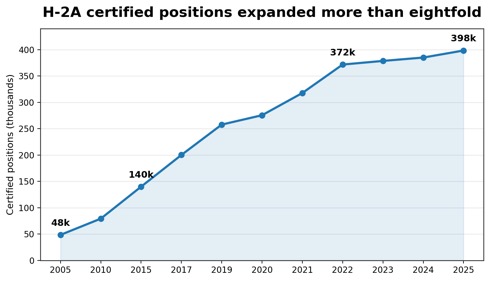
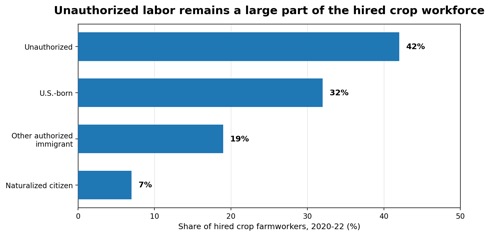
The available evidence therefore does not support a simple substitution story in which lawful guest workers gradually displaced unauthorized labor. American agriculture became dependent on both systems at once.2
That does not prove H-2A caused unauthorized employment, or vice versa. It demonstrates a narrower but important point: changing the legal source of workers has not fundamentally reduced agriculture's dependence on foreign labor.
Congress has promised to control the source of farm labor. It never built a strategy for reducing agriculture's dependence on it.
The recurring failure is conceptual: policymakers have tried to solve an investment problem primarily through immigration policy.
If the agricultural labor debate had remained frozen in 1986, Congress's emphasis on worker supply might still be defensible. At that time, many labor-intensive tasks had no realistic mechanical substitute. That is no longer true across large portions of agriculture.
Large-scale grain production has been mechanized for generations. In dairy, USDA research documents increasing use of automatic takeoffs, activity monitors, and robotic milking systems; these technologies can reduce milking labor and generate detailed management data. Greenhouses rely on automated irrigation and climate controls. Packing facilities use machine vision to inspect, grade, and sort produce with speed and consistency.9
Specialty-crop automation is more uneven, but the pace of development is real. USDA's Agricultural Research Service describes labor-saving automation as a research priority and is developing robotic systems for apples and other specialty crops. Field tests of an ARS-supported apple-harvesting robot reported fruit-detection rates above 90 percent in tested orchards and picking success that varied substantially with canopy conditions, illustrating both the progress and the remaining limitations.10,11
The credible position lies between two exaggerations. Not every farm job can be automated today. But agricultural automation is no longer science fiction.
The relevant question is no longer whether agriculture can automate. It is which tasks, for which crops, at what cost, and how quickly.
Technology changes the denominator in the immigration debate. If a farm historically required one hundred seasonal workers and commercially viable equipment reduces that requirement to eighty, immigration policy no longer needs to solve for one hundred. If additional technologies reduce demand further, the effect compounds season after season.
Capital investments also differ fundamentally from visas. A visa supplies labor for one season. A robotic packing line, autonomous implement, or precision-spraying platform can reduce labor demand for years.
The benefits extend beyond headcount. Automation can improve quality, reduce waste, extend operating windows, lower chemical use, increase safety, and generate data that improves future production.
This matters as American agriculture confronts pressures larger than immigration alone. The country has fewer farms than it did twenty years ago, average operations are larger, and the producer population is moving toward retirement age.7
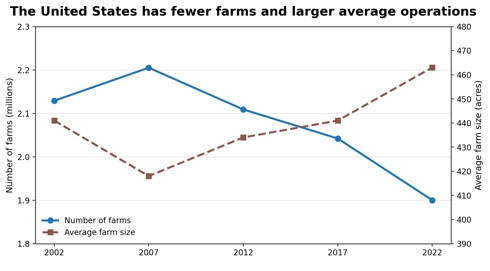
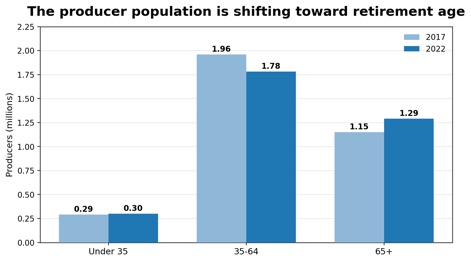
Automation will not reverse every cause of consolidation or solve succession on its own. But it can help a smaller workforce operate more productively, reduce the physical burden of farm work, and make technologically sophisticated agriculture more attractive to a new generation.8
Ultimately, the goal is not universal automation. It is faster adoption where commercially proven technology already exists.
That leaves the central question: if the equipment is increasingly capable and the labor problem is persistent, why is adoption still so slow?
Modernization is expensive, and its costs arrive before its benefits.
A robotic harvesting platform, automated packing line, or autonomous tractor may reduce operating costs for a decade or more. But the purchase price arrives before those savings. Producers must secure financing, integrate the system, train workers, absorb downtime, and accept technology and maintenance risk.
Seasonal labor is costly, but it is paid through the ordinary production cycle. Automation converts a recurring operating expense into a large capital commitment. A project can offer an attractive long-term return and still remain impossible to finance today.
The public debate often assumes farms choose labor because they prefer it. Many choose labor because it is easier to finance.
For smaller and mid-sized farms, the problem is especially acute. Large firms typically have stronger balance sheets, dedicated capital-planning staff, and deeper lender relationships. Smaller operations may confront collateral limits, volatile commodity prices, weather risk, and lenders unfamiliar with specialized equipment that has little resale market.
The missing ingredient is not innovation. It is affordable capital.
This pattern is not unique to agriculture. Technological revolutions often require financial innovation before they reach mass adoption. Rural electrification depended on long-term lending structures. Small-business expansion relies in part on federal loan guarantees. The thirty-year mortgage transformed a large upfront purchase into a manageable stream of payments.
Agricultural automation presents the same basic mismatch: long-lived assets produce benefits over many years, while available credit may be too short, too expensive, or too dependent on conventional collateral.
The public benefits also extend beyond the borrower. Lower dependence on foreign labor makes immigration enforcement less disruptive. Higher productivity strengthens domestic food production. Precision systems can reduce waste and improve the use of water, fertilizer, and crop-protection products. Demand for robotics and automation supports domestic manufacturing, software, engineering, installation, and maintenance.
Because many benefits extend beyond the individual borrower, markets may invest more slowly than is socially optimal. Public policy does not need to replace private investment to address that problem. It can help financing better match the useful life and public value of the asset.
To be clear: the choice is not between intervention and a costless status quo. The current system already carries public costs: recurring shortages, persistent illegal employment, repeated visa expansions, and delayed productivity growth.
A credible transition must offer producers an economically practical way to comply with stronger enforcement rather than presenting them with a sudden labor cutoff and no path to adapt.
A modernization policy should be temporary, market-oriented, and tied to measurable change. It should finance a transition away from labor dependence, not subsidize the dependency itself.
The core mechanism should rely primarily on private lending supported by federal guarantees, long repayment terms matched to equipment life, and limited interest assistance where necessary. This structure has clear federal precedents. USDA's Farm Service Agency already guarantees farm ownership and operating loans made by commercial lenders and can cover up to 95 percent of qualifying losses; SBA's 7(a) and 504 programs likewise use guarantees and long-term financing to support business equipment and fixed assets. Loans preserve underwriting discipline and must be repaid. Guarantees should cover only a defined share of principal, require meaningful borrower equity, and be priced or reserved against expected losses.12,13
Eligibility should be technology-neutral but outcome-focused. Congress should not select manufacturers or proprietary systems. Qualifying investments should be commercially deployable rather than basic research, materially reduce labor requirements or raise output per worker, and support repayment through documented productivity gains. Independent technical review should be available for unfamiliar equipment, but the government should not guarantee performance or protect borrowers from ordinary commercial risk.10
Tax policy should reinforce financing, but it should begin from current law rather than duplicate benefits that already exist. Permanent 100 percent bonus depreciation now generally applies to qualifying property acquired after January 19, 2025. The stronger case for new legislation is therefore a narrowly defined investment credit for qualifying labor-saving systems, paired with carryforward or transfer rules so smaller producers with limited current tax liability can use it. Congress should preserve full cost recovery and avoid stacking duplicative benefits beyond what is necessary to accelerate adoption.16
Credit and tax policy solve different problems. Financing answers whether the producer can buy the equipment. Tax treatment helps determine whether buying it produces an acceptable return.
But favorable financing cannot be unconditional. Participation should require a direct commitment to lawful employment.
The government provides the bridge; the producer commits to crossing it.
To qualify, a borrower should enroll in E-Verify for all future hires and remain enrolled throughout the loan term. Because ordinary E-Verify generally does not permit employers to re-verify an existing workforce, the authorizing statute would need to create a one-time, program-specific verification process for incumbent employees, modeled where appropriate on the federal-contractor rule. That process should include notice, a meaningful opportunity to resolve tentative nonconfirmations, anti-discrimination protections, and a reasonable cure period. Public financing intended to reduce illegal-labor dependence should not support an operation that continues relying on unauthorized employment.14
This condition turns the financing mechanism into a transition contract. The producer receives access to affordable capital. In exchange, the producer modernizes, verifies future hires, completes the one-time incumbent-worker process authorized by Congress, and operates under a lawful hiring system going forward.15
The sequence matters. Enforcement without alternatives can cause severe disruption. Financing without enforcement can become an ordinary subsidy. Together, they reinforce each other: modernization lowers the cost of compliance, while E-Verify ensures that modernization advances the immigration objective.
The policy should also build domestic capacity to install and maintain advanced equipment. Community colleges, land-grant universities, vocational programs, extension services, and manufacturers can train technicians, mechanics, robotics operators, and precision-agriculture specialists.
Smaller and family-owned farms require particular attention. Lower down payments, longer terms, streamlined applications, technical assistance, and equipment-sharing cooperatives can keep modernization from becoming another advantage available only to the largest operations.
Critically, the assistance must sunset. Congress should establish a fixed authorization window, declining subsidy rates for later cohorts, and no authority to originate new loans after the statutory H-2A phase-down is complete. The government would retain only the authority necessary to service, audit, and enforce outstanding loans. Once equipment has been financed and installed, it can continue producing returns without annual federal support.
The relevant comparison is not financing versus doing nothing. It is temporary support for permanent productivity versus indefinite management of labor dependence.
The program should include annual lender and agency reporting, risk-based fees, portfolio loss estimates, random audits, and public disclosure of aggregate performance by technology, sector, and borrower size.
Borrowers should certify that financed equipment remains in qualifying agricultural use. Sale, export, related-party transfer, or conversion to a nonqualifying use during a defined recapture period should require agency approval and may trigger repayment of tax benefits or modification of loan terms.
Eligibility violations should be graduated. Administrative errors should receive a cure period; material misrepresentation, immigration fraud, wage-law violations, or diversion of proceeds should trigger clawbacks, accelerated repayment, guarantee denial, and debarment.
These safeguards matter because a transition program succeeds only if it remains narrower than ordinary farm support and demonstrably advances the immigration and productivity objectives that justify it.
Markets do adapt, and credible deadlines are necessary to create urgency. But the pace and cost of adaptation matter. An abrupt cutoff without a capital pathway would create the greatest disruption in labor-intensive sectors that have the fewest immediate alternatives.20
Financing does not replace enforcement. It makes enforcement durable by reducing the number of workers farms need before the labor supply is withdrawn.
It should not be. The statute should contain fixed application deadlines, declining assistance, repayment requirements, annual portfolio reporting, and continuing authority only to service and enforce outstanding loans. Congress should require reauthorization for any extension rather than permit automatic continuation.
The distinction is between paying a recurring cost every year and financing a one-time investment that reduces the recurring cost.
The purpose is not to compensate for past behavior. It is to change future behavior. Borrowers would receive financing only in exchange for modernization, E-Verify participation, clean I-9 audit results or an approved cure agreement, and lawful hiring going forward. Material immigration, wage, or program fraud should trigger loss of favorable terms, accelerated repayment, guarantee recapture, or debarment.
Public policy frequently uses incentives to produce forward-looking compliance. The relevant question is whether the bargain reduces future illegal employment at a reasonable public cost.
Without safeguards, large operations would likely absorb a disproportionate share. That is why guarantee levels, fees, technical assistance, loan set-asides, and shared-equipment structures should favor smaller producers.
Large firms should not necessarily be excluded; they account for a substantial share of the labor demand the policy seeks to reduce. But guarantee percentages and interest assistance should decline with borrower size, and the largest firms should bear more private risk. Separate allocations or fee preferences can protect access for small and family-owned operations.
It will not replace every worker, and the policy should not pretend otherwise. The standard should be measurable labor reduction where commercially viable technology exists.
Even partial reductions matter. A ten- or twenty-percent reduction across labor-intensive sectors can reduce shortages, make enforcement less disruptive, and allow the remaining workforce to become more productive.
The market is already producing the technology. The unresolved question is whether existing credit and tax structures will adopt it quickly enough to support a deliberate immigration transition.
A temporary guarantee does not ask Washington to design machinery or operate farms. It uses private underwriting and repayment to accelerate investment that produces public benefits beyond the individual borrower.
Congress has spent decades managing agricultural labor dependence - alternating among visas, legalization, employer sanctions, and enforcement while leaving the demand side largely untouched.
The country now faces a choice between two models of adaptation.
The first treats labor demand as fixed. When workers are scarce, government finds more workers, tolerates unlawful employment, or postpones enforcement. Modernization occurs, but only at the pace created by private incentives under a labor system that remains comparatively accessible.
The second model deliberately reduces labor demand. It uses credible enforcement to create urgency, temporary financing to make adaptation possible, and tax policy to reward capital investment rather than recurring dependency.
These are not merely competing immigration policies. They are competing visions of American agriculture.
One asks how America can keep supplying enough workers. The other asks how America can produce more food while needing fewer of them.
Agriculture will modernize at different speeds across crops and regions. Some operations can be automated extensively now. Others will still require human labor for years. A serious policy should acknowledge that diversity without losing sight of the destination.
Every major agricultural revolution has reduced the amount of labor required to produce more food. Agricultural output rose through mechanization, improved genetics, irrigation, scientific management, GPS guidance, and precision agriculture. Robotics and artificial intelligence are the next chapter of that history.
The second Trump administration's July 2025 AI Action Plan calls for faster adoption and distribution of AI technology across economic sectors and organizes federal action around innovation, infrastructure, and international leadership. USDA's FY2025-2026 AI Strategy is the department's first comprehensive framework for integrating AI into its mission. A farm-modernization transition fits naturally within that governing framework: producing more at home through advanced American capital while preparing workers to operate and maintain it.17,18
Reducing dependence on foreign agricultural labor is therefore more than an immigration objective. It is an opportunity to modernize a critical industry, strengthen food security, create skilled technical work, and give smaller farms a better chance to compete in a capital-intensive future.
America should not spend the next forty years debating where the next farmworker will come from. It should spend them building an agricultural economy that needs fewer workers to produce more food.
The most durable answer to agricultural labor shortages may not be another visa bill. It may be the machinery, software, and financing that make the next visa unnecessary.
The author thanks Pax (@1776Pax) for his substantial assistance designing and developing the interactive companion website. Any errors or omissions remain the author's own.
Interactive figures, downloadable datasets, source documentation, methodology notes, and supplemental policy material are available at the companion website:
https://agricultural-modernization.pages.dev
The sources below are listed in order of first appearance in the article.
1. U.S. Department of Labor, Office of Foreign Labor Certification, H-2A Temporary Agricultural Program - Selected Statistics, FY2025, reporting 398,258 positions certified. https://www.dol.gov/sites/dolgov/files/ETA/oflc/pdfs/H-2A_Selected_Statistics_FY2025_Q4.pdf
2. USDA Economic Research Service, Legal Status of Hired Crop Farmworkers, Fiscal 1991-2022. In 2020-22, 42 percent of surveyed hired crop farmworkers lacked work authorization. The series excludes H-2A and livestock workers. https://www.ers.usda.gov/data-products/chart-gallery/63466
3. Ronald Reagan, Statement on Signing the Immigration Reform and Control Act of 1986, November 6, 1986. https://www.reaganlibrary.gov/archives/speech/statement-signing-immigration-reform-and-control-act-1986
4. Immigration Reform and Control Act of 1986, commission study requirement concerning modern labor-management techniques in agriculture. https://www.govinfo.gov/content/pkg/COMPS-10559/pdf/COMPS-10559.pdf
5. U.S. Government Accountability Office, H-2A Agricultural Guestworker Program: Changes Could Improve Services to Employers and Better Protect Workers, HEHS-98-20, describing four to five million Bracero work authorizations from 1942 to 1964. https://www.gao.gov/assets/hehs-98-20.pdf
6. U.S. Government Accountability Office, Immigration Reform: Potential Impact on West Coast Farm Labor, HRD-89-89, discussing mechanization after Bracero and the crop-specific tomato experience. https://www.gao.gov/assets/hrd-89-89.pdf
7. USDA National Agricultural Statistics Service, 2022 Census of Agriculture. The United States counted 1,900,487 farms in 2022, with an average size of 463 acres. https://www.nass.usda.gov/Publications/AgCensus/2022/Full_Report/Volume_1,_Chapter_1_US/
8. USDA National Agricultural Statistics Service, Farm Producers: 2022 Census of Agriculture Highlights. Producers ages 35-64 declined 9 percent from 2017, while producers age 65 and older increased 12 percent; average producer age was 58.1. https://www.nass.usda.gov/Publications/Highlights/2024/Census22_HL_FarmProducers_FINAL.pdf
9. USDA Economic Research Service, Precision Dairy Farming, Robotic Milking, and Profitability in the United States, ERR-356. https://ers.usda.gov/sites/default/files/_laserfiche/publications/113706/ERR-356.pdf
10. USDA Agricultural Research Service, Reducing Labor and Advancing Precision Agriculture Through Automation. https://www.ars.usda.gov/research/annual-report-on-science-accomplishments/fy-2021/reducing-labor-and-advancing-precision-agriculture-through-automation/
11. USDA Agricultural Research Service, field evaluation of an apple-harvesting robot, including detection and picking-performance results. https://www.ars.usda.gov/research/publications/publication/?seqNo115=403763
12. USDA Farm Service Agency, Guaranteed Farm Loans. FSA guarantees qualifying commercial farm loans and currently lists maximum guaranteed loan amounts above $2 million. https://www.fsa.usda.gov/resources/loans/guaranteed-farm-loans
13. U.S. Small Business Administration, 7(a) Loans and 504 Loans, federal precedents for guaranteed and long-term fixed-asset financing. https://www.sba.gov/funding-programs/loans/7a-loans
14. U.S. Citizenship and Immigration Services, E-Verify FAQ: ordinary employers may not verify existing employees, except federal contractors subject to the FAR E-Verify clause. https://www.e-verify.gov/faq/may-i-verify-an-existing-employee-in-e-verify
15. U.S. Citizenship and Immigration Services, Federal Contractors and Verifying New and Existing Employees on Form I-9. https://www.e-verify.gov/employers/federal-contractors/verifying-new-existing-employees-on-form-i-9
16. Internal Revenue Service, Notice 2026-11, permanent 100 percent additional first-year depreciation for qualifying property acquired after January 19, 2025. https://www.irs.gov/newsroom/treasury-irs-issue-guidance-on-the-additional-first-year-depreciation-deduction-amended-as-part-of-the-one-big-beautiful-bill
17. The White House, America's AI Action Plan, July 2025. https://www.whitehouse.gov/wp-content/uploads/2025/07/Americas-AI-Action-Plan.pdf
18. U.S. Department of Agriculture, Fiscal Year 2025-2026 AI Strategy. https://www.usda.gov/sites/default/files/documents/fy-2025-2026-usda-ai-strategy.pdf
19. U.S. Department of Labor, H-2A Temporary Agricultural Program, defining covered work as agricultural labor or services of a temporary or seasonal nature. https://www.dol.gov/agencies/eta/foreign-labor/programs/h-2a
20. USDA Economic Research Service, U.S. Fruit and Vegetable Industries Try To Cope With Rising Labor Costs, describing rising labor costs, increased H-2A reliance, and producer use of machinery. https://www.ers.usda.gov/amber-waves/2022/december/u-s-fruit-and-vegetable-industries-try-to-cope-with-rising-labor-costs