
American Intelligence
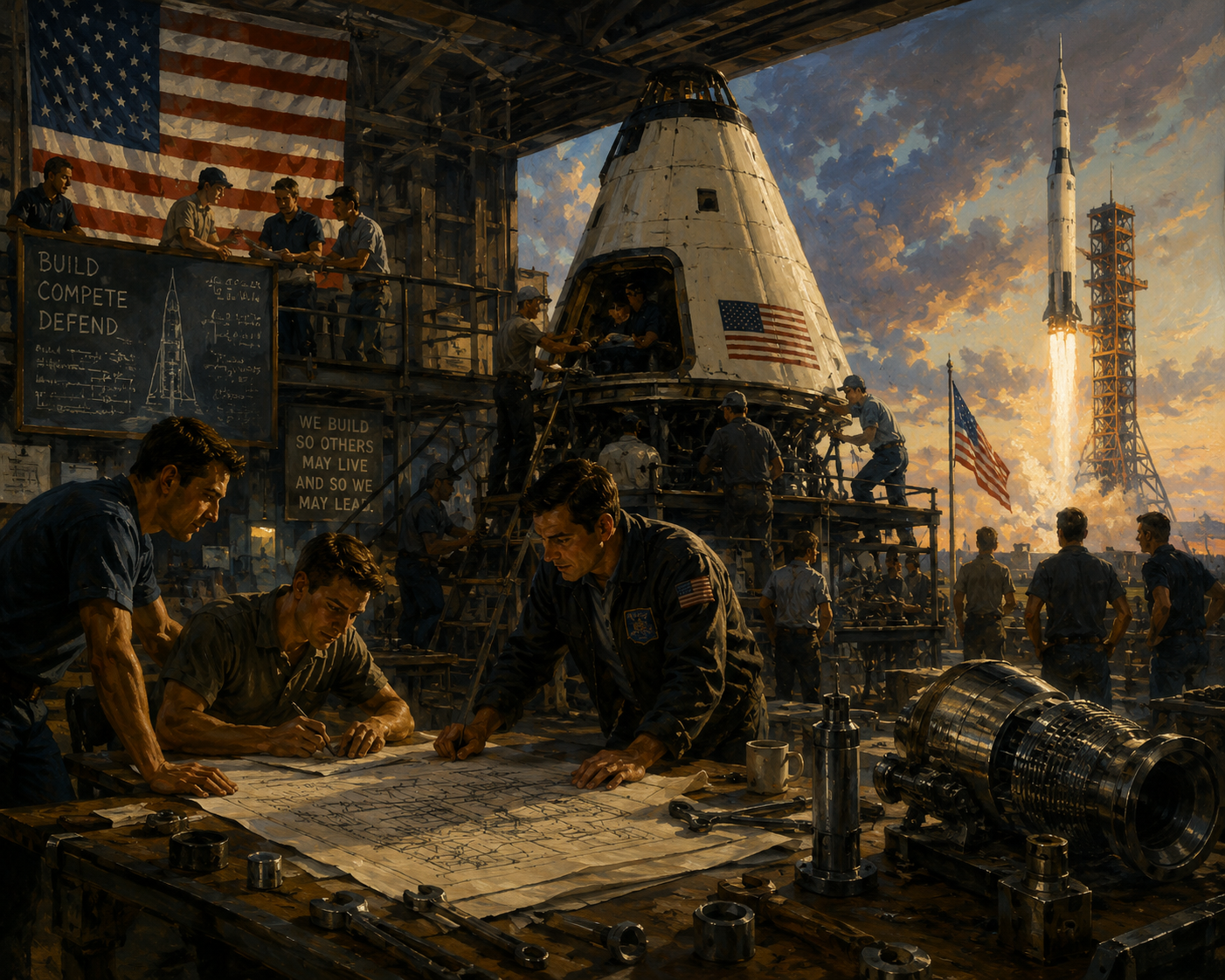
For the past generation, the story of American innovation ran through Silicon Valley. Software scaled, capital flowed, and the smartest talent in the country was funneled into building digital products that could grow fast and cost cheap. The United States became world-class at building apps while allowing its capacity to build physical systems, including our energy infrastructure, to erode. That model delivered extraordinary results, but also left something to be desired. As a result, manufacturing was weakened and supply chains were stretched thin; innovation thus drifted further from production. Founders focused on the IPO and getting the biggest headline in Wired Magazine.
America was optimized for efficiency, not resilience.
Now, a different model is emerging, one that policymakers in Washington would be wise to take seriously. Artificial intelligence is accelerating it.
While a lot of the AI debate in Washington remains stuck on chatbots, safety frameworks, and hypothetical risks, on the ground, AI is already doing something more concrete: it is lowering the barrier to building in the physical world. Design cycles are compressing and simulation is improving. Small teams can now take on projects that once required massive organizations.
In short, AI is making it easier to build real things again. It is proliferating outside of Silicon Valley and has ignited a promise for exportation across the nation: any community can become a hotbed for innovation and opportunity.
El Segundo, California, a 5.5 square-mile coastal city in Los Angeles County is an example of this phenomenon. It has become a growing cluster of aerospace and defense startups that are applying AI to complex, real-world systems. Companies like Varda Space Industries are exploring manufacturing in orbit and returning materials to Earth. A project that demands precision, autonomy, and reliability.
In El Segundo, an exciting culture is forming. Engineers are not optimizing for engagement metrics but solving for performance under constraint. And unlike Silicon Valley, this community is taking a different form. Outside LA these founders and engineers regularly gather outside the office for bonfires, shared meals, and even Bible studies. Reinforcing the idea that what they are building is not just a company, but a mission. Last fall I visited “the Gundo” and walked through one of these new start-ups. It wasn’t what I expected, sounds of remixed Free Bird and American flags on full display. This isn’t Silicon Valley and that is NOT a bad thing.
A similar dynamic is taking shape in Lockhart, Texas where a group of intrepid entrepreneurs started “Proto Town” to rethink how innovation communities are built. Founders and their teams live and work in close proximity, sharing tools, collaborating in real time, and increasingly relying on AI-driven workflows to accelerate development.
The cultural signals are hard to miss. Communal barbecues and even more American flags. A visible sense of shared purpose. This is not the diffuse, networked culture of Silicon Valley but is more cohesive, more intentional, and explicitly tied to the idea that building matters not just economically, but nationally and spiritually.
Then there is Detroit, host city for the Reindustrialization Summit, where a tonal shift is on full display. This annual conference brings together entrepreneurs, policymakers to discuss how the US can reindustrialize across the nation. These discussions are exciting and different, including a talk last year from Palmer Luckey via a robot. The topics of the talks are on expanding capacity, improving supply chains and rethinking our nation’s industry strategy. In the midst of Detroit, a city which embodies the scars and lessons of not preparing adequately for the future, these attendees are plotting out a different path, one of hope and optimism.
As investor John Phelan put it at last year’s conference, “We’ve spent the last 10 years teaching people how to code… we’re going to spend the next 10 years teaching people how to use their hands.” It is a simple observation, but it captures the moment. The pendulum is swinging back toward building that which is tangible.
Taken together, these developments point to something larger than a sectoral shift. They reflect a rebalancing of American innovation, away from pure abstraction and back toward production.
In every one of these places that the throughline is that AI is the catalyst. It is making physical innovation faster, cheaper, and more accessible. Yet also these communities are demonstrating that the future of AI is tied to the real importance of human-to-human interaction. The collaboration of people working to solve problems never seen before.
These emerging ecosystems are rebuilding the habits, communities, and expectations that make sustained production possible. And that has real implications for policy.
If AI is going to accelerate a new era for American builders, Washington should not stand in the way. Permitting reform, regulatory clarity, and a renewed focus on infrastructure and industrial capacity are essential. Capital should be encouraged not discouraged to flow into hard tech, manufacturing, and defense innovation.
Just as important, policymakers should recognize that innovation is no longer confined to a single region. The next phase will be more distributed, more physical, and more rooted in place.
While Silicon Valley is not going away, it is no longer the whole story. The next chapter of American leadership will not be written solely in code. It will be built in factories, in workshops, and in communities across the country that are rediscovering what it means to make things again.
AI will help power that shift. The question is whether we are ready to follow it.