
American Intelligence

Palantir CEO Alex Karp recently sparked controversy when he said that AI will erode the labor market position of , “highly educated, often female voters who vote mostly Democrat” while boosting “vocationally trained working-class, often male voters.” If true, he’s describing a titanic power shift. He’s describing the possible unraveling of the postwar economic model that shaped modern American life, relationships, and family formation.
For the last sixty years, American society has increasingly organized itself around a simple assumption: fulfillment comes through individual economic achievement. Career advancement, financial independence, and professional identity became not only economic goals, but cultural ideals. For women especially, economic independence was presented as liberation itself, a hard won “freedom” from dependence and constraint.
This cultural model emerged alongside profound changes in the American economy after World War II. As the country transitioned from a manufacturing economy toward a service and administrative economy, millions of new jobs emerged that rewarded routine cognitive work rather than physical labor. Offices expanded. Bureaucracies multiplied. The economy increasingly favored coordination over production, emails over machines, and administration over craftsmanship.
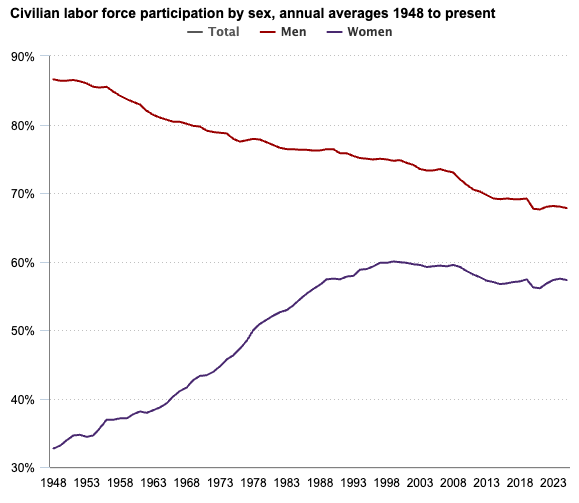
Women entered this expanding white-collar economy in enormous numbers and succeeded within it. Today, women between the ages of 25 and 34 have achieved near wage parity with men nationally and out-earn men in several major metropolitan areas. They are also substantially more likely than men to hold bachelor’s degrees (47% vs 37%). By many measurable standards, they achieved what earlier generations fought for: unprecedented educational and economic opportunity.
Yet, economic progress alone did not, and cannot, fully resolve deeper questions of meaning, stability, and fulfillment.
Over the same period that educational and professional gains accelerated, measures of anxiety, depression, loneliness, and declining life satisfaction rose across society. Women in particular experienced what economists Betsey Stevenson and Justin Wolfers famously described as the “paradox of declining female happiness”: despite major gains in income and opportunity, self-reported well being declined relative to previous generations and in both relative and absolute numbers compared to men.
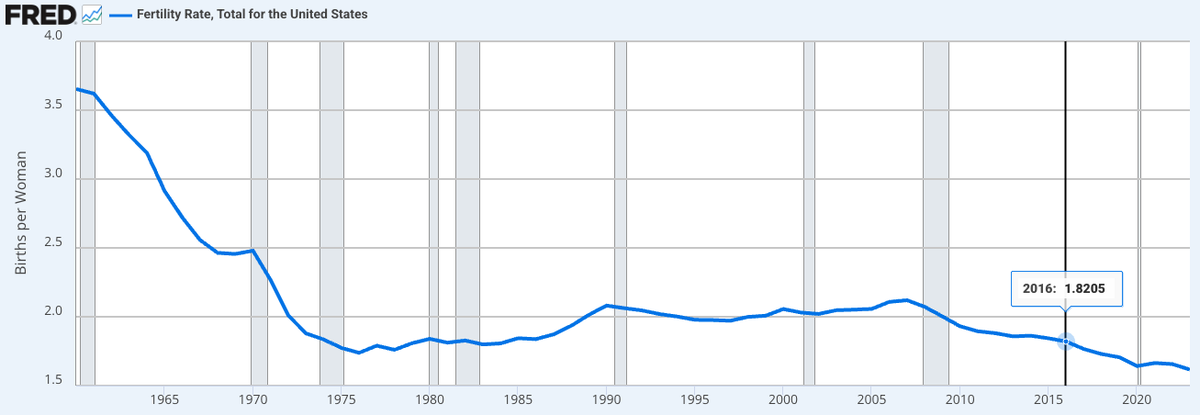
The postwar labor market reshaped not only careers, but the structure of family life itself. Reliable white collar career paths made delayed marriage and prolonged singlehood increasingly rational economic choices for both men and women. Marriage shifted from an economic partnership toward a primarily emotional institution between financially independent individuals. The median age of first marriage steadily climbed while fertility rates steadily declined. Median age at first marriage for women climbed from about 20 in 1960 to late 20s and early 30s today. The U.S. total fertility rate fell from 3.5 births per woman in 1960 to record lows, hovering at around 1.6 today.
Economics, not ideology alone, helped drive these changes. And this is where AI enters the picture.
When people discuss AI driven labor disruption, they might focus on factory automation or blue collar displacement. But modern AI systems are especially effective at performing these routine cognitive and administrative tasks: scheduling, coordination, documentation, compliance work, basic analysis, and other forms of bureaucratic labor. These are precisely the types of jobs that formed the backbone of the postwar white collar expansion which was largely centered around the explosion of female labor force participation.
In other words, from a labor perspective, AI is not primarily attacking the industrial economy of the early twentieth century. It is increasingly compressing the services economy that replaced it.
As mentioned, Early research already suggests that occupations centered around routine administrative and cognitive work face some of the highest levels of AI exposure. Because women became disproportionately represented in many of these professions over the last several decades, the effects of this transition may not be evenly distributed, even if the technology itself is neutral in intent.
But the deeper implications extend far beyond gender or labor statistics.
For decades, economic life increasingly rewarded radical individualism: maximizing optionality, delaying commitment, prioritizing career mobility, and treating relationships, marriage, and family as secondary to professional development. The stability once provided by family, community, and local institutions was gradually replaced by labor market participation itself. Work became identity for men and women alike.
If AI weakens the long term stability of white collar professional ladders, it may also weaken the social assumptions built on top of them.
In a more economically volatile environment, households and families may once again become important forms of risk sharing, stability, and resilience. Earlier partnership and family formation could become more economically attractive again, not because society is “going backward,” but because the underlying economic incentives are changing.
The coming transition may also produce a broader cultural realignment. Historically, periods of economic disruption often push people to search for deeper forms of meaning, structure, and belonging. The Covid era, for example, produced measurable increases in religious interest and widespread reevaluation of work centered lifestyles. AI driven disruption may accelerate similar questions on a much larger scale.
Call it Christian Futurism: not a rejection of technology, but an exploration of its unexpected human consequences.
Paradoxically, the same technologies feared for making human labor less necessary may ultimately create more space for the parts of life that people consistently report mattering most: relationships, family, faith, community, and purpose. AI productivity gains could reduce the centrality of bureaucratic labor in everyday life and reopen cultural space for ways of living that the modern economy often treated as inefficient or irrational.
Critics will rightly argue that workers will adapt, reskill, and move into new industries. Many undoubtedly will. New technologies always create new forms of opportunity. But the speed and scale of AI disruption still matter. The professional ladders that structured modern middle class life for generations may shrink faster than new ones fully emerge.
And for many people, especially women, and especially younger generations already exhausted by hyper competitive careerism and rising social isolation, that shift may not feel purely threatening. It may also create an opening to reevaluate what prosperity is actually for. Women who once delayed family to protect career momentum may find that the calculus has changed, where getting married and pairing up no longer feels like a sacrifice, but rather an economic hedge against a very uncertain labor market.
If even part of this transformation materializes, the long term effects could extend well beyond economics. Higher marriage rates, stronger families, lower social isolation, higher fertility, and improved well-being may ultimately emerge not from political campaigns or cultural lectures, but from changing material realities themselves.
AI is not coming to punish ambition, independence, or professional success. But it may unintentionally expose the limits of organizing society primarily around labor market achievement. In doing so, it could help restore social importance to the relationships and institutions that technological modernity gradually pushed to the margins.
Technology does not necessarily have to compete with family, faith, or human connection. In an unexpected twist, it may end up strengthening them, especially for the women who have borne the hidden costs of this new labor market of the last sixty years.